ABC welcomes John Klicka on September 22, 2016

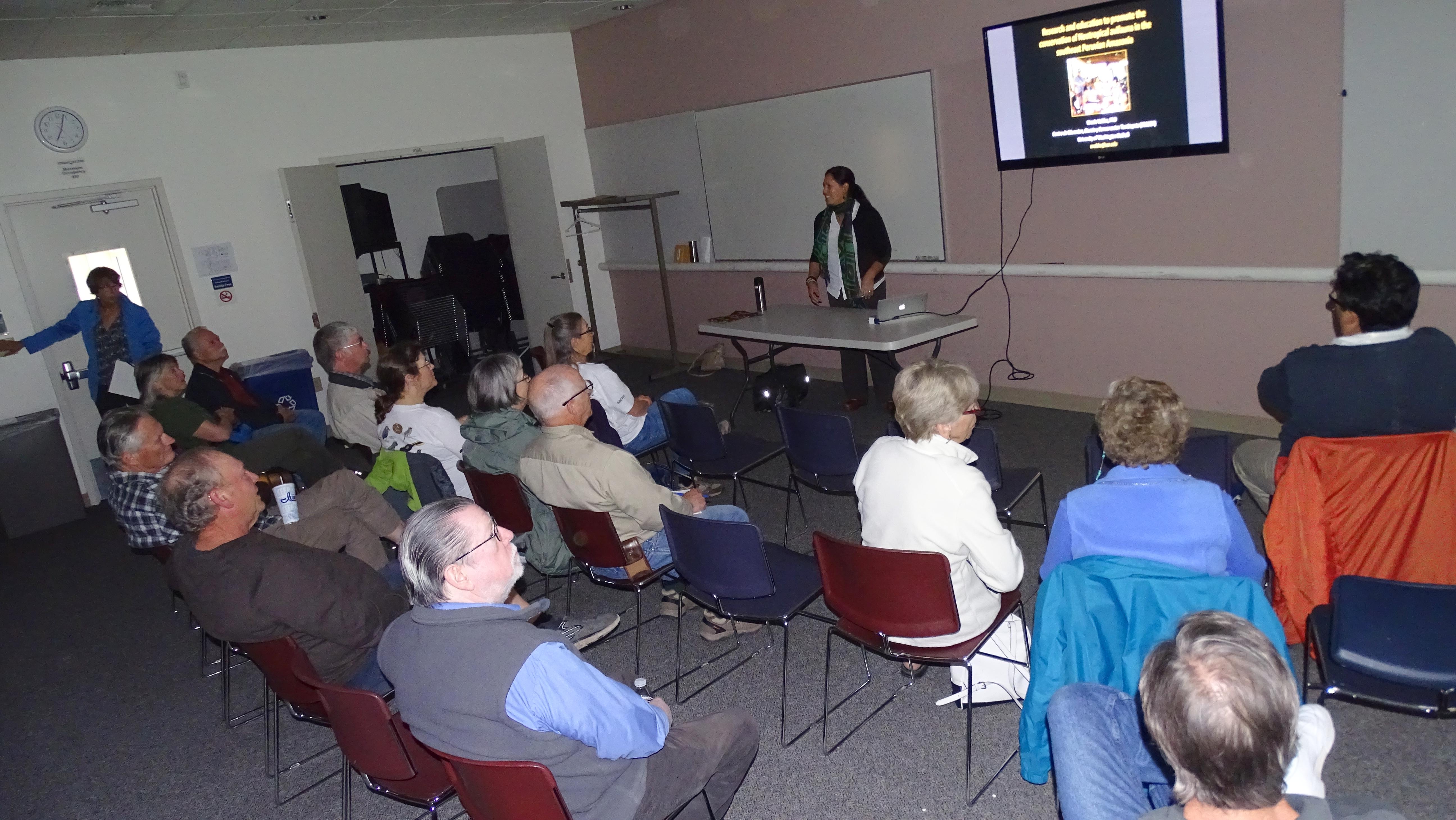
SEPT 22, 2016, 6:45 PM, Pierce County LIbrary Administration Bldg, 3005-112th St. E., Tacoma 98446: John Klicka!  $10 speaker fee.

John Klicka, Curator of Birds at UW.

John Klicka, Curator of Birds at UW.

Join us in welcoming John Klicka, Curator of Birds at the Burke Museum, University of Washington, who will be our honored guest. He tells us, “I will be talking about some of the research that I have done recently. Basically, what we do here in my lab is take traditional museum questions regarding taxonomy, behavior, and morphology, and we attempt to answer them using modern museum tools (molecular methods, DNA analyses). In this way, I will touch on the taxonomy of sparrows, attempt to determine just how many of species of “House Wren” actually exist, and look at levels of genetic connectivity between bird populations occupying mountain-top habitats throughout western North America.”


For more info on Dr. Klicka and the Klicka Lab at the U, see his website:
https://klickalab.com/john-klicka/

ABC WELCOMES BACK PETER HODUM, JUNE 14, 2016

    ABC WELCOMES BACK PETER HODUM, JUNE 14, 2016:
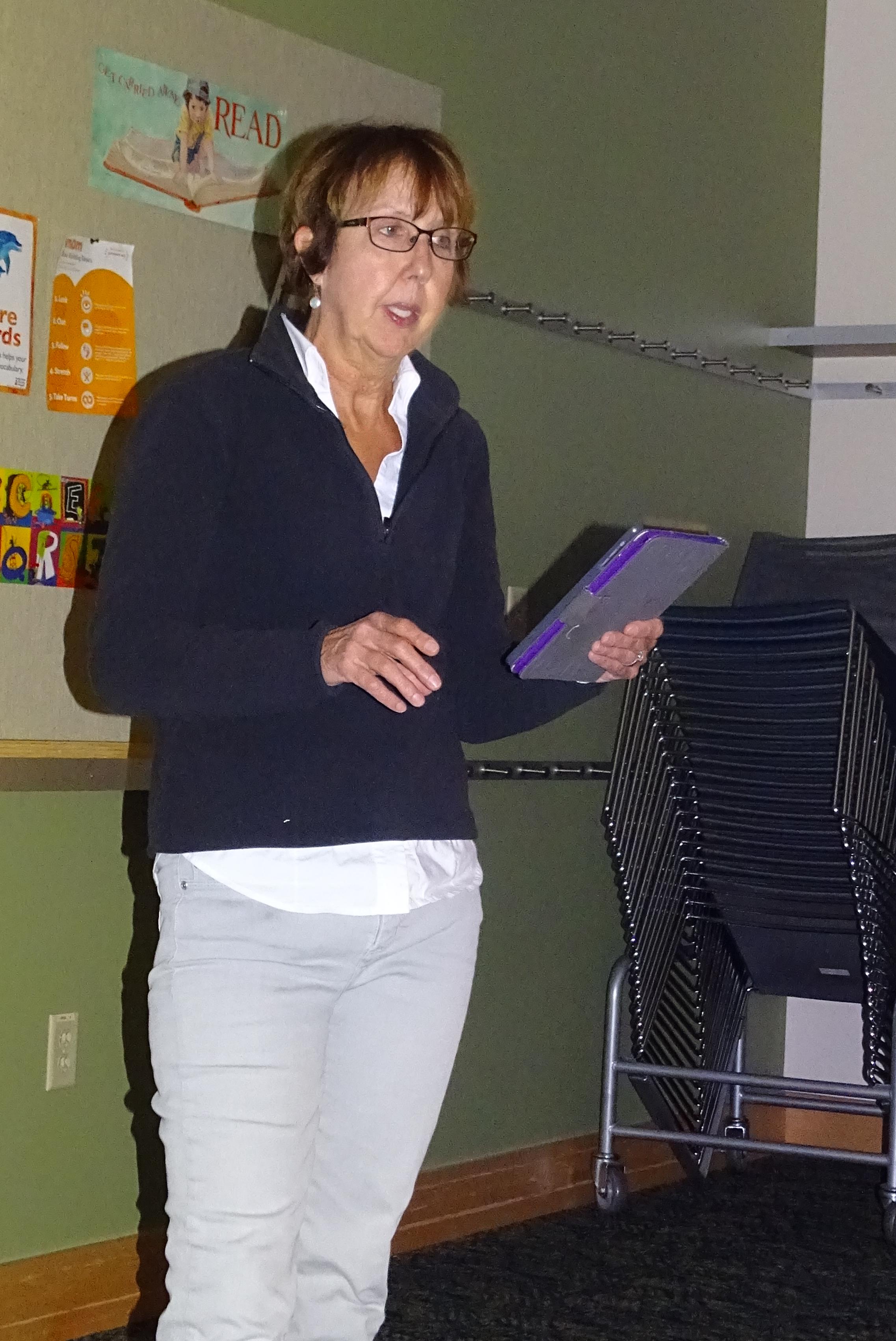
ABC program director Kay Pullen introduces Dr. Peter Hodum.

ABC program director Kay Pullen introduces Dr. Peter Hodum.

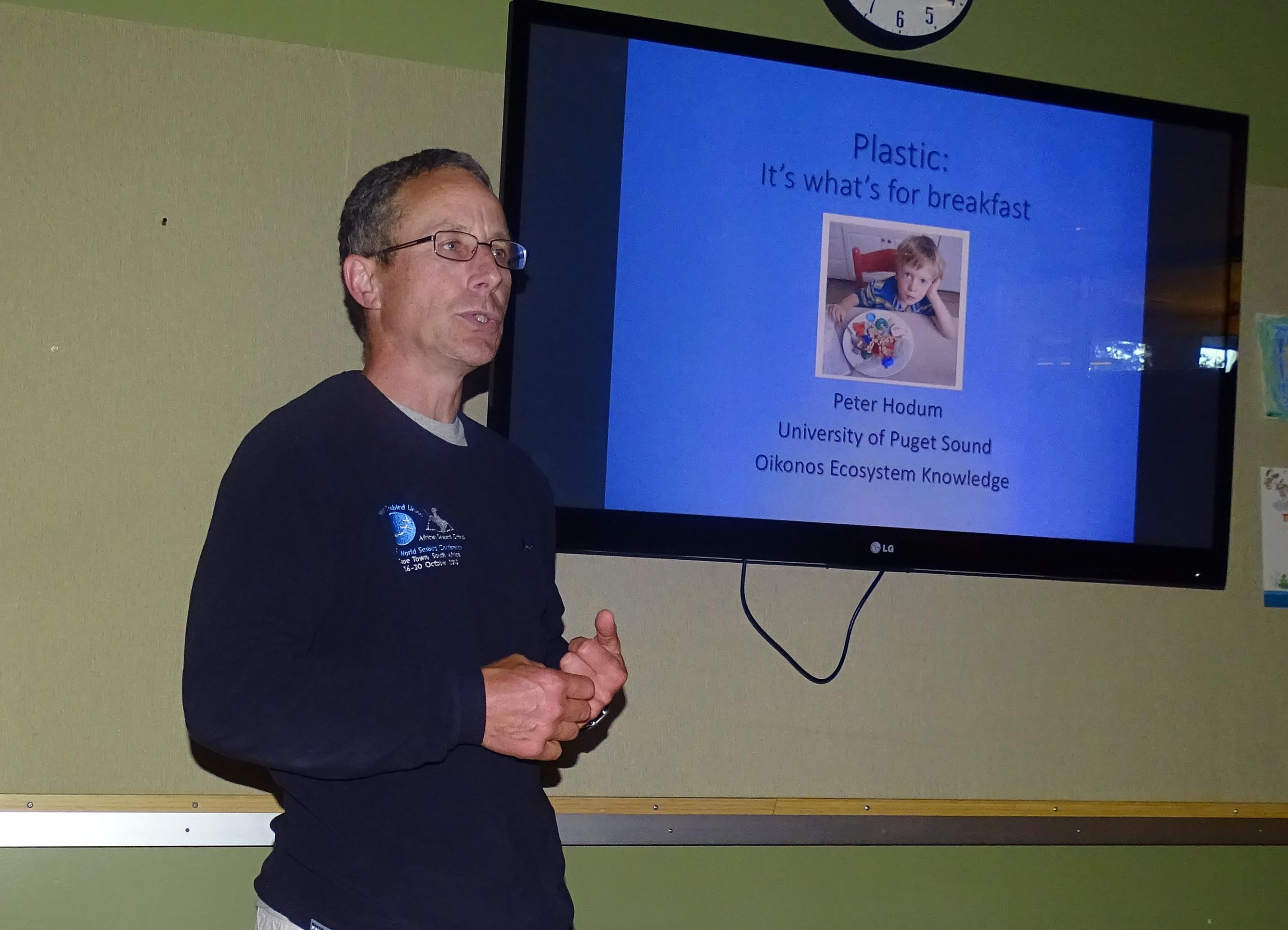
Peter Hodum's presentation: Plastic: It's what's for breakfast

Peter Hodum’s presentation: Plastic: It’s what’s for breakfast

Dr. Hodum from UPS came back for the third time and promised us another visit the next year, which we will hold him to. His first visit was about his work as a seabird ecologist and conservation biologist on Chile’s Juan Fernandez Islands in conjunction with Oikonos Educational and Conservation project, of which he is a founder (http://oikonos.org/). Then he came back and talked about seabirds nesting off the coast of Washington and educated us that Rhinoceros Auklets are really Puffins. Now for his encore he talked to us about a passion he never imagined he’d have — the growing problem of plastics littering the earth and especially the ocean where now most seabirds as well as their forage fish and benthic (had to look that one up!) prey have plastic debris, macro-, meso-, or microplastics, in their guts. The earth is now a “plastisphere.”

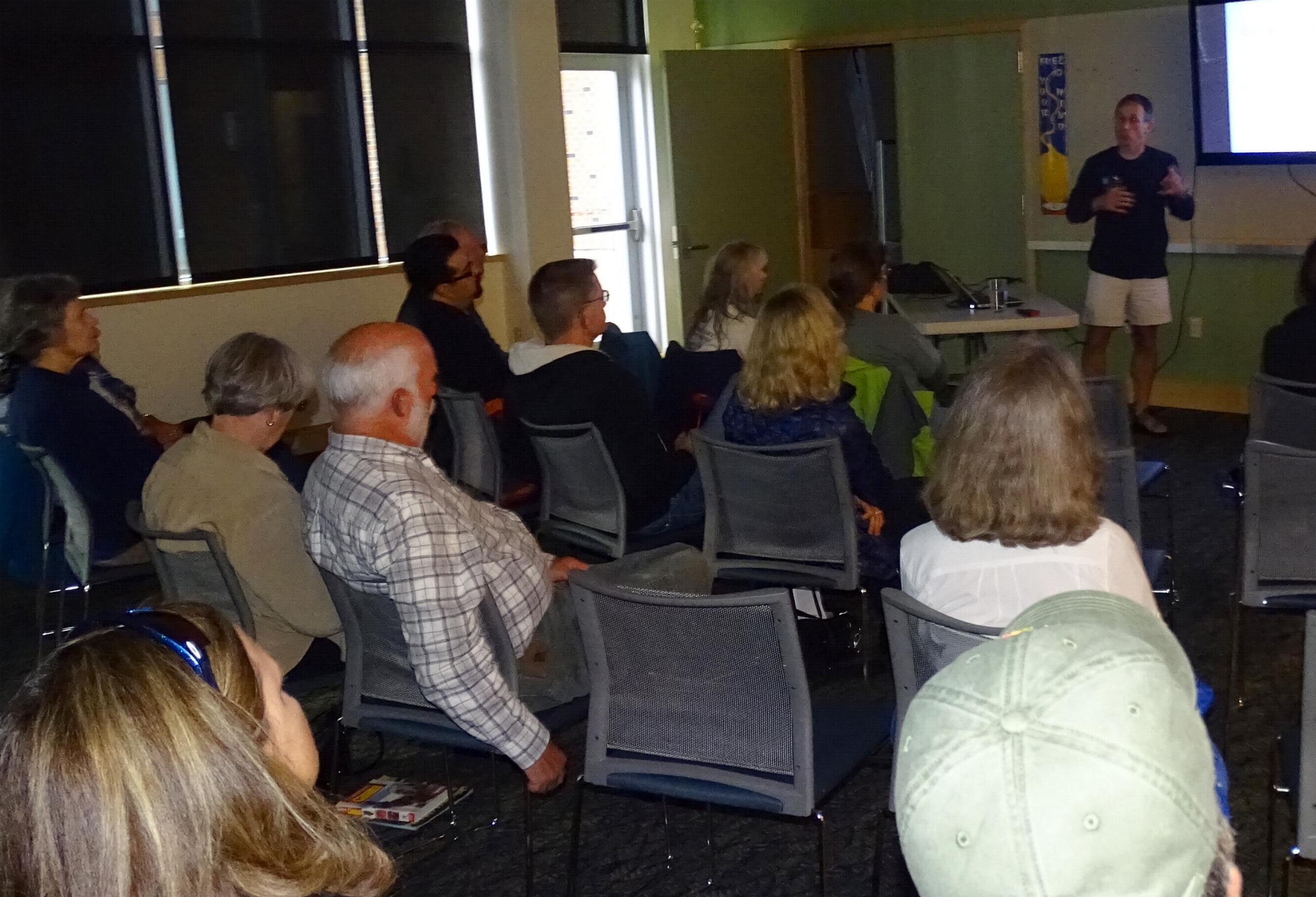
Explaining the rise of plastics since WWII.

Explaining the rise of plastics since WWII.

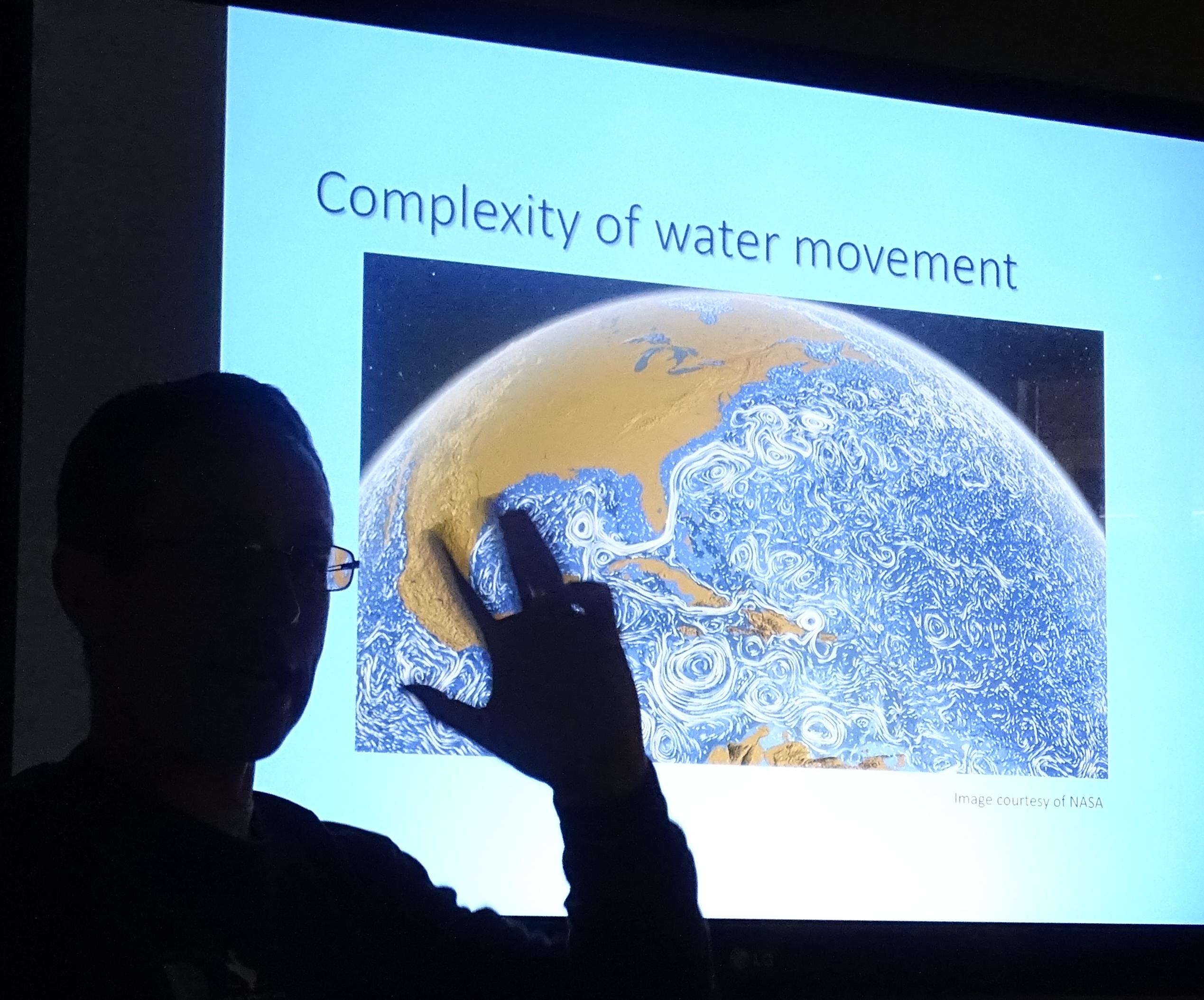
Peter talked the ocean currents inevitably spreading the plastics and pointed to a map, telling us it’s better as an animation.

NASA has put together animations of this; see their website below.

NASA has put together animations of this; see their website below.

NASA actually has a series of animations collectively called the Perpetual Ocean, which are absolutely fascinating. Study these before you send a message in a bottle:

http://svs.gsfc.nasa.gov/vis/a010000/a010800/a010841/index.html

The currents do demonstrate a likely scenario for the formation of ocean garbage patches that have been talked about a lot lately. A question from the audience elicited that Peter doesn’t think these can be cleaned up with the engineering, money, or the will currently out there, but doesn’t discount future cleanups. His current advice is to take responsibility for the plastic you put out there.

Northern Fulmars and Sooty Shearwaters were used as examples of two species that surprisingly have quite different foraging habits, especially relating to the depths at which they collect food. This corresponds to different plastic types (including different colors!) and different amounts found in each, with almost all Fulmars, feeding on the surce, found with plastics, corresponding to just under 60% of deeper diving Shearwaters.

Forage fish were found to have mostly filament-type micro-plastics ingested, which of course continue to degrade, but stick around in the birds that prey on them.

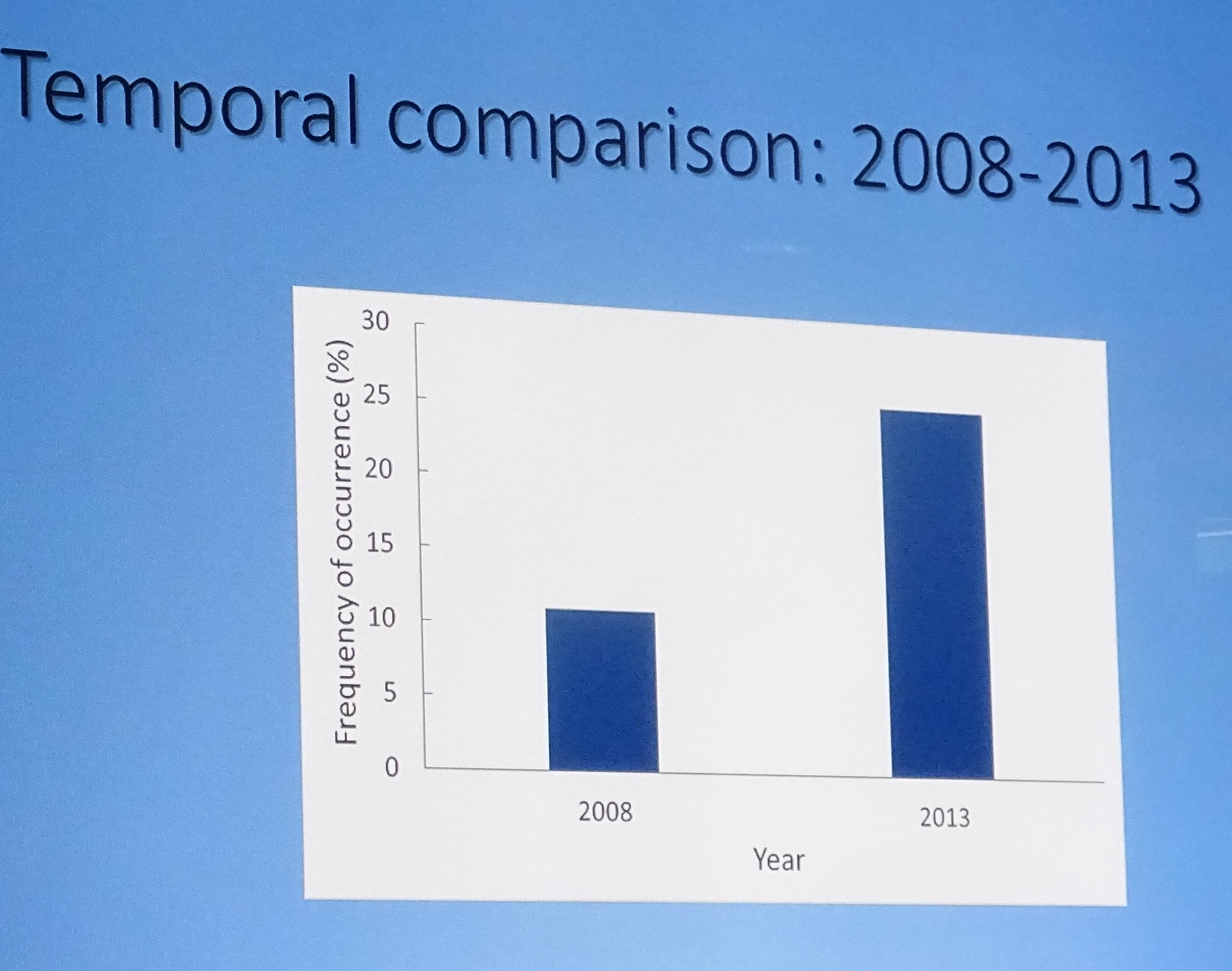
The most chilling statistic of the evening was a simple bar chart showing real differences on an upward trend since 2008 in ocean plastics (frequency of occurrence).

Now THIS is scary.

Now THIS is scary.

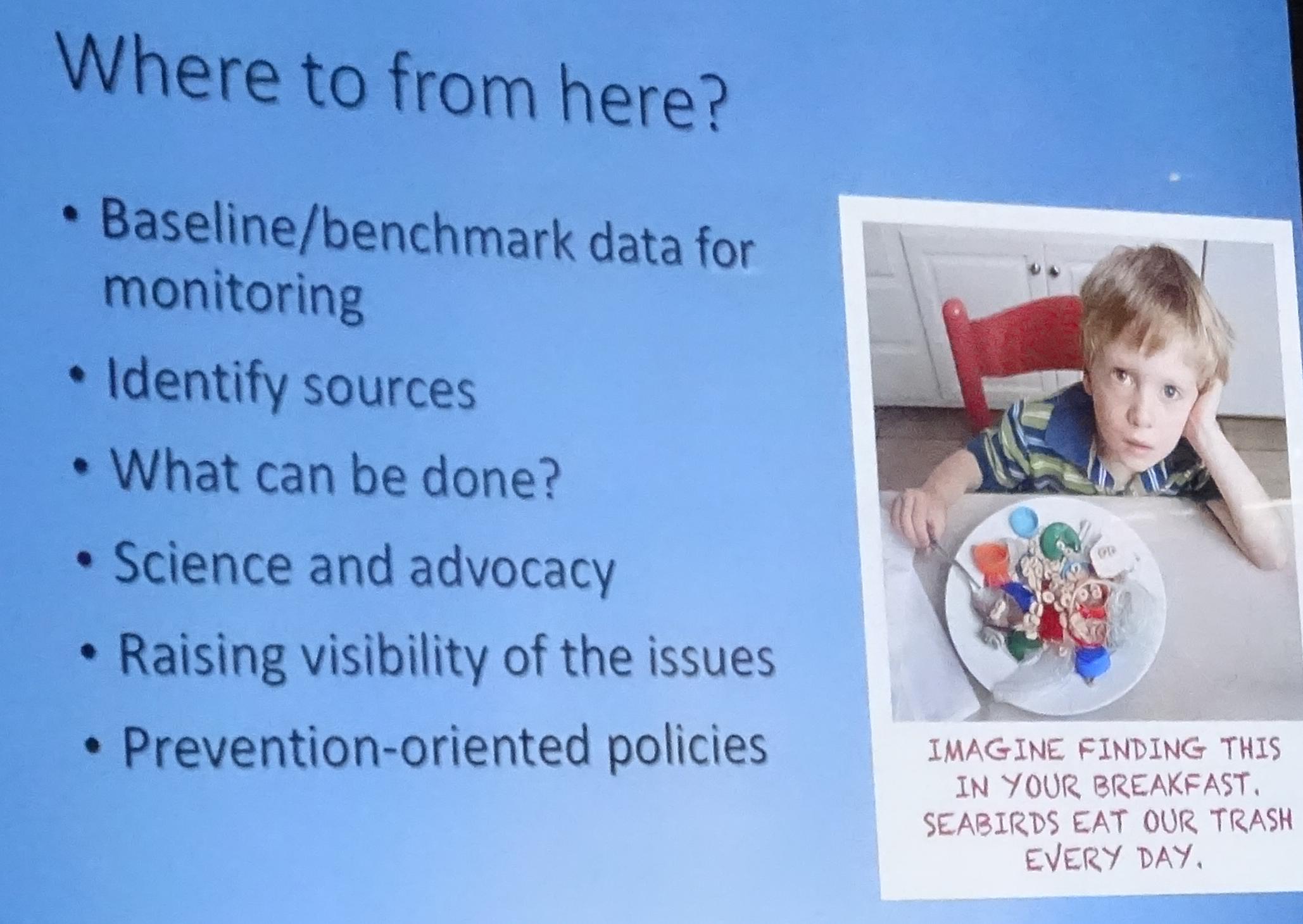
Peter finished up by talking about what we can do with his own targets of science and advocacy among them. He did not condemn plastics en masse, realizing how vital they are to our lives in so many ways, but urged responsible use and disposal.

Here's what can be done now.

Here’s what can be done now.

JUNE 14, 2016 – PETER HODUM at ABC!

Tuesday, June 14, 2016:

ABC monthly lecture series presents, Dr. Peter Hodum speaking about his research:

PLASTIC: IT’S WHAT’S FOR BREAKFAST!

Tuesday, June 14, 6:45 – 8:45 pm

University Place Library Meeting Room

3609 Market Place W, Suite 100

University Place, WA 98466

$10. All are welcome.

***************************

The issue of plastic debris in the oceans is of growing concern globally, with plastic accumulating in marine habitats from the equators to the poles and from coastlines to the middle of ocean basins. Although patterns of plastic ingestion by marine wildlife such as sea turtles, marine mammals and seabirds are increasingly well documented, the consequences of ingestion remain poorly understood. The pervasiveness of marine plastics, especially micro-plastics, throughout marine food webs is also unknown. In this talk, Peter Hodum will discuss the magnitude of the marine plastic pollution issue, the impacts of plastic debris on marine wildlife, and the use of biological indicators, ranging from seabirds to mussels, to better understand the impacts of plastics on marine ecosystems. He will also talk about the challenges and opportunities of dealing with this global environmental issue.

Dr. Peter Hodum is an associate professor at the University of Puget Sound and the Chile Program Director for Oikonos Ecosystem Knowledge, a conservation non-profit organization. In Chile, Dr. Hodum leads a long-term program dedicated to conducting applied conservation research, restoration and community-based conservation programs. His research focuses primarily on the conservation and ecology of threatened seabirds and island ecosystems in Chile and here in Washington State. His research program also focuses on issues related to marine plastic debris and its impacts on marine wildlife. He is an enthusiastic educator who loves working in the field and with communities, both locally and internationally.

MAY 2016: Dr. Ursula Valdez excites ABCers

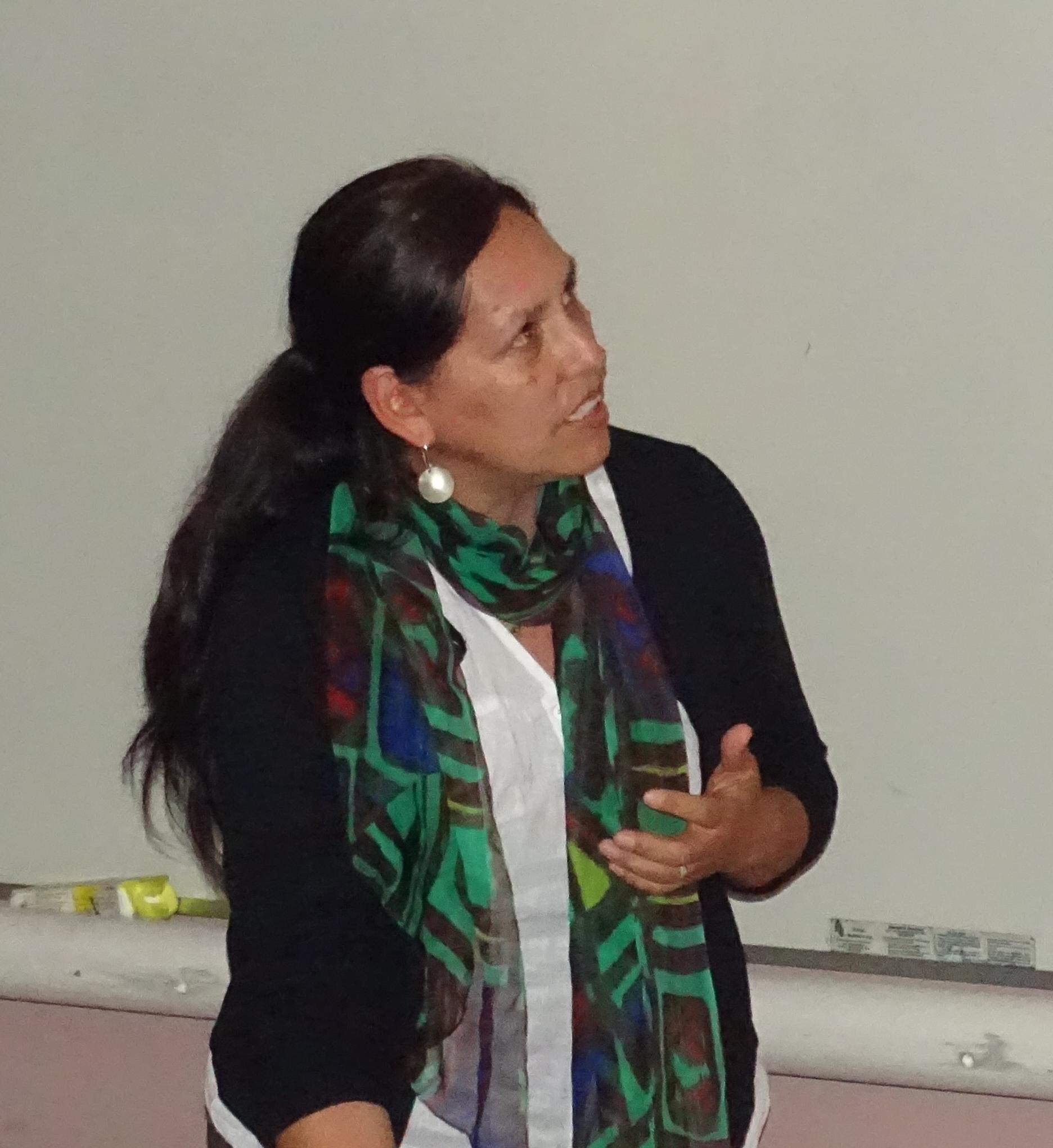
Dr. Ursula Valdez puts a point across to ABCers.

Dr. Ursula Valdez puts a point across to ABCers.

ABC WELCOMES URSULA VALDEZ, May 18, 2016:

Dr. Ursula Valdez thrilled our group with her knowledge and her passion, both for her birds and for the loss of habitat in her homeland, Peru. Now teaching at UW-Bothell, she straddles two vastly different worlds and draws them together.

Dr. Valdez presents her multimedia summary to ABC.

Dr. Valdez presents her multimedia summary to ABC.

Dr. Valdez is a founder of Centro de Educacion, Ciencia y Conservacion Tambopata (CECCOT) in the Madre de Dios area of SW Peruvian Amazonia, which trains students about the local avifauna. Five years in, the first students are now running the place, to the delight of all. The focus is on research including bird census and banding, as well as education in conservation and sustainability.

 
We moan about overdevelopment around here, but our local problems pale with the devastation of Amazonia. Dr. Valdez’s research has been mainly in the Madre de Dios area, a spot of record biodiversity, where she and her students have documented many hard-to-find species of birds and some true rarities. Nevertheless, slash-and-burn continues to impact this region more every day, for agriculture including soy and palm oil, cattle, logging, and road building, now with a major highway through Peru from Brazil to the Pacific. Cutting the forest is bad enough, but burning the slag has made smoke a major pollutant spreading way beyond localities, impacting human health and much more.

 
If there was one topic that made Dr. Valdez even more unhappy than deforestation, it was gold mining. Gold fever, as ever, makes mankind insane, crazy enough to risk their own lives with unsafe mercury handling and not caring about what else is at stake. Methods of mining completely gut the land, as demonstrated by Dr. Valdez’s startling photos. This is land that now can never be returned to habitat. Much of it is illegal, which barely slows it down, and human trafficking is rife in these areas as well.
Dr. Valdez did mention that political change is coming, just very, very slowly. Peru has national parks and reserves, but no funds or will to maintain them. They have a cabinet position that’s just for show at present, but at least it’s there in case they ever get a firebrand in the job. And there’s a national election coming which could help or hinder.

 
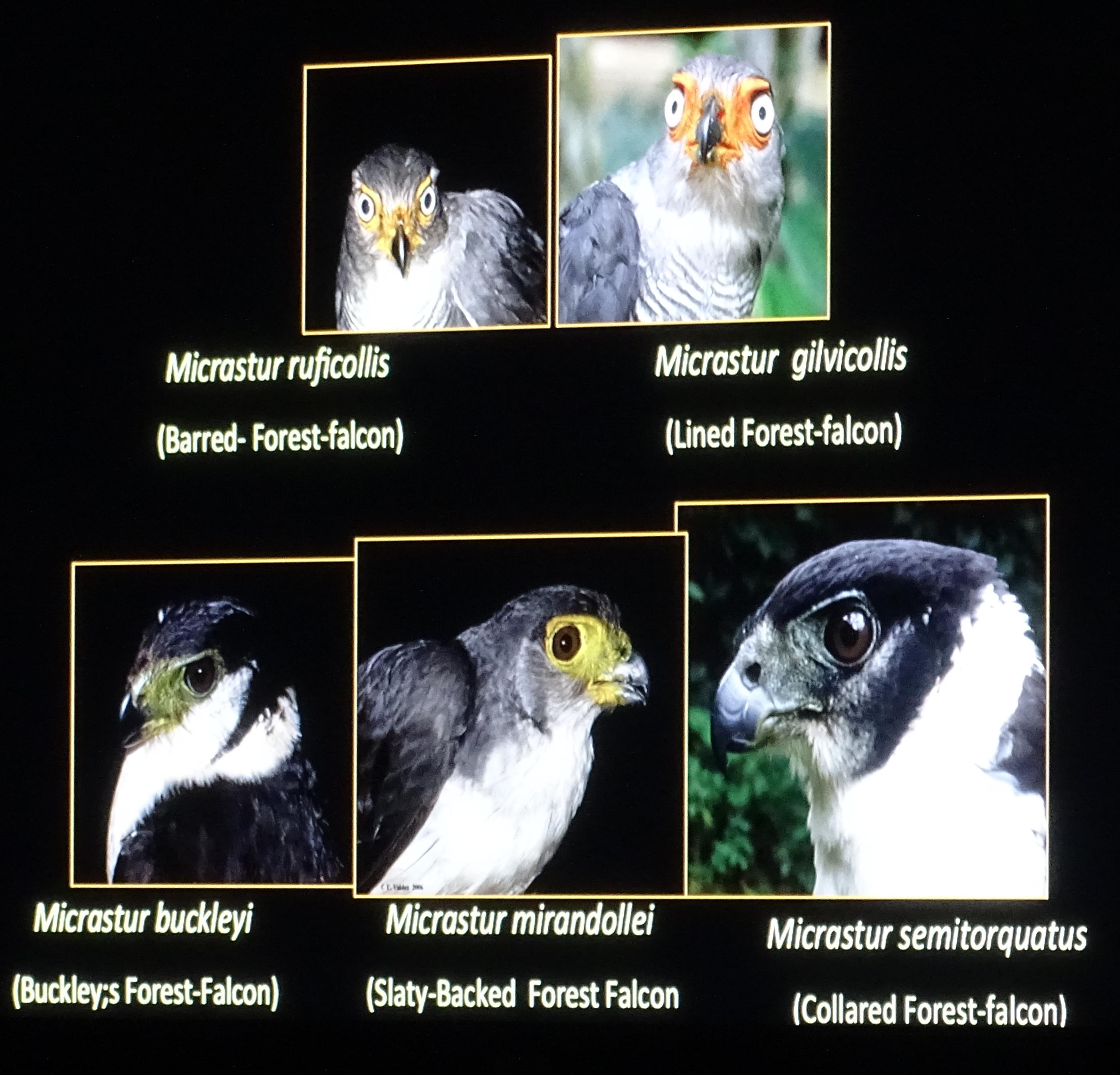
One thing Ursula Valdez did talk about happily was Forest-falcons! Her favorite birds and a main target of her personal research! She showed a slide of the five species found in her area of Peru, including two that are rarely seen, which she concentrated on, Buckley’s and Slaty-backed Forest-falcons. She also showed slides of several other colorful and unusual birds found in her area which her students have found and documented, including Band-tailed Manakin, Rufous-fronted Antthrush, Amazonian Motmot (now split from more northern birds), the very musical Musician Wren, and the Black-spotted Bare Eye, an obligate army ant camp follower, helping to sweep all bugs away.

The 5 species of Forest-falcons in the Madre de Dio region of Peru.

The 5 species of Forest-falcons in the Madre de Dio region of Peru.

Dr. Valdez has invited ABCers to come down and put in some time with her group next spring, and Kay Pullen will be obtaining information on that prior to the dates involved. Ursula has made believers out of us!

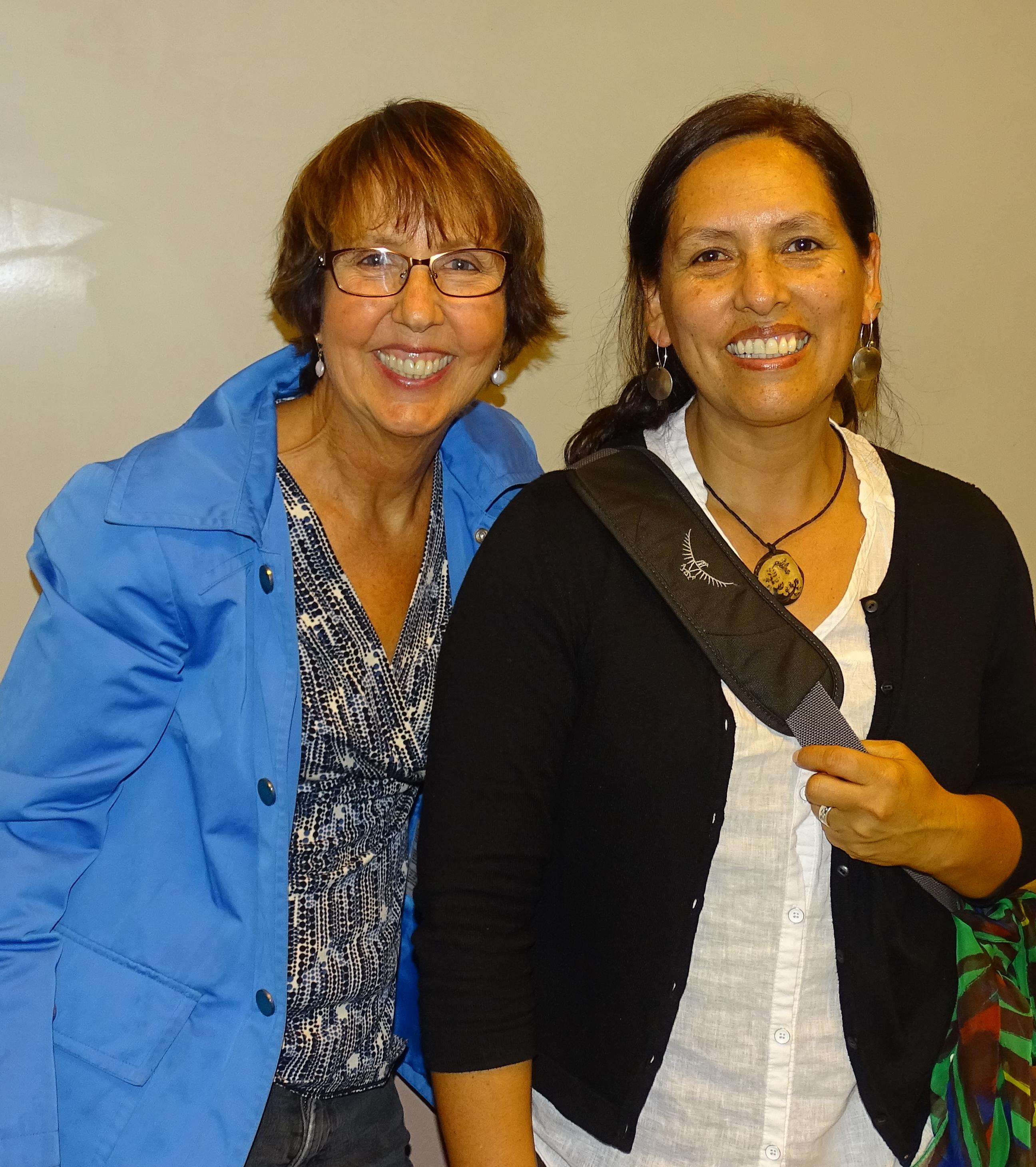
ABC program director with guest presenter, Dr. Ursula Valdez

ABC program director with guest presenter, Dr. Ursula Valdez

MAY 18, 2016: ABC welcomes Dr. Ursula Valdez

ABC EVENT:  MAY 18, 2016, 6:45 PM, Pierce County Library Administration Building, 3005 112th St E, Tacoma, WA 98446 (near Highway 512).

ABC is excited to welcome Dr. Ursula Valdez to speak about research and education to promote the conservation of Neotropical avifauna in the southeast Peruvian Amazonia.

The Madre de Dios region in Southeastern Peru, harbors one of the richest biodiversity in the Amazonian rainforest region and in the world. At the same time, this area is affected by high rates of habitat loss as a result of rapid human expansion, deforestation and illegal gold mining.  Over the past 5 years at the Centro de Educacion, Ciencia y Conservacion Tambopata (CECCOT), we have been documenting the distribution and abundance of avian species with the goal to evaluate the impacts of habitat change on these species. We have also developed a conservation program that aims at training local students in research and conservation practices with the goal to increase awareness on the conservation of the local forest and to promote sustainable living practices.  In my talk, I will be describing the bird research we do in this region and will offer information on the natural history of a few fascinating species found in the area. I will also talk about the conservation work we do in collaboration with local students of Madre de Dios.


Dr. Ursula Valdez is a Peruvian Tropical Ecologist and Conservation Biologist. She graduated as a biologist from the Universidad Nacional Agraria La Molina in Lima Peru. She holds a M Sc in Zoology from NCS, and a PhD in Biology from the University of Washington. She is currently a faculty member at UW Bothell, where she instructs on courses in Natural History, Ecology, conservation & sustainability and a study abroad program in Peru. She conducts ecological research on bird communities in UWB campus. She is the director of CECCOT and conducts bird research in Peru.

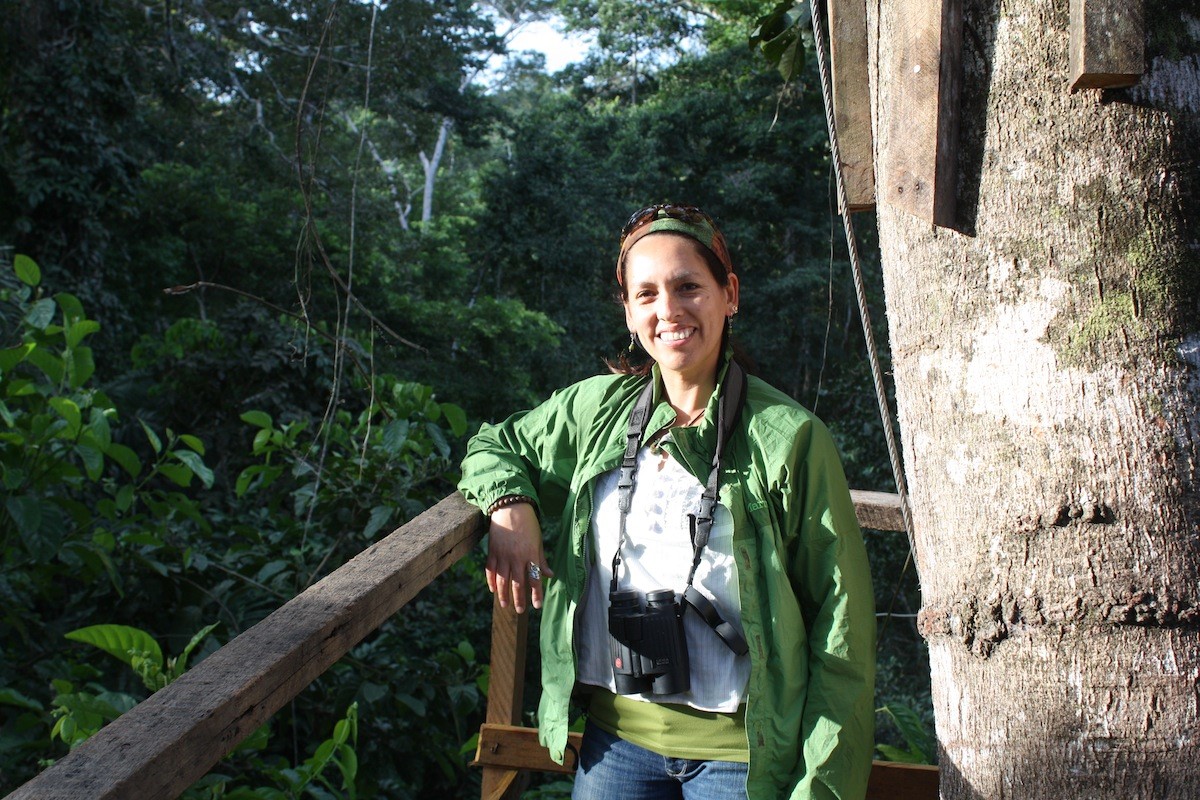
ABC's distinguished guest speaker for May 18, 2016

ABC’s distinguished guest speaker for May 18, 2016

ABC field trip April 10, 2016 with Andy Stepniewski

ABC SHRUB-STEPPE FIELD TRIP, APRIL 10, 2016

They don’t call Andy Stepniewski “Steppie” for nothing, as he is a foremost authority on Shrub-Steppe habitats in the northwest. Andy and his wife Ellen met us at 6:30 a.m. Sunday morning after we’d all had exciting treks eastward on Saturday. Amazingly, we had a blazing sunrise and perfect weather! None of that wind Andy had forebodingly warned us about.

With most of us westerners just enjoying our first spring birds in early April, it was interesting to hear Andy tell us that on the Shrub-Steppe, all the action is March through May, with summer and winter quiet times for birds as well as vegetation. He quoted Dennis Paulson who said something along the lines of, “There is no place so dead in Washington in the wintertime as the Shrub-Steppe.”

The wildflowers and of course those all-important bunchgrasses, of which there are a bunch, were studied in depth in person. More information on these plants and habitats is to be found in, “Birds of Yakima County, 2nd Edition,” by Andy, of course. It’s available from Yakima Valley Audubon on their website:

http://yakimaaudubon.org/wp-content/uploads/sites/6/2015/08/Birds-of-Yakima-County.doc.pdf

Even though Andy operates out of Yakima County, the Shrub-Steppe does not obey artificial county bounds, so the field trip spent lots of time in Kittitas and Grant counties, visiting several well-known hot spots as well as some unknown sites to some of us.

Besides bunchgrasses and flowers, sagebrush and its look-alikes are king. Andy had us smell and taste the leaves of a sage and a bitterbrush to bring us into the zone. View some of his comments on the FLICKR site below. Moviette was too large to load here.

As for birds, a few of us were thrilled to be birding east of the mountains BEFORE the arrival of those nasty empidonax flycatchers who live to confuse us. Most of our expected and desired species were seen, with particularly thrilling looks and listens at Long-billed Curlew, Wilson’s Snipe, Sandhill Crane, Black-necked Stilt, and COPULATING American Avocets! Other exciting birds included White-throated Swifts, Great Horned Owl, Loggerhead Shrike, Mountain Bluebirds, Horned Larks, and of course those Shrub-Steppe specialties, Sagebrush Sparrow, Brewer’s Sparrow, and Sage Thrasher, seen and heard well. The soundtrack for the day was provided by Vesper Sparrows and Western Meadowlarks. Feasts for eyes and ears!

The flowers were mostly elfin, and some of them grew in bunches, looking like bouquets! Ellen was frequently taken aside by the botanizers among us, and flowers were ID’d and photographed. Those people who stand tall miss so much at toe height! With Ellen being an expert in this field, those two Stepniewskis make quite a power couple.

Special thanks goes to Kay Pullen who helped pull this field trip together along with the sparrow workshops with Dennis Paulson earlier in the week. Then she kept track of all the species for eBird, too!

Many photos were taken. Laurel and Heather will put links to their photos in the Comments section of this site when they’ve had a chance to edit them. Anyone else who wants to share photos is encouraged to do this, also, such as Richard. Diane’s photos are on FLICKR at:
https://www.flickr.com/photos/76552838@N03/albums/72157664855173204

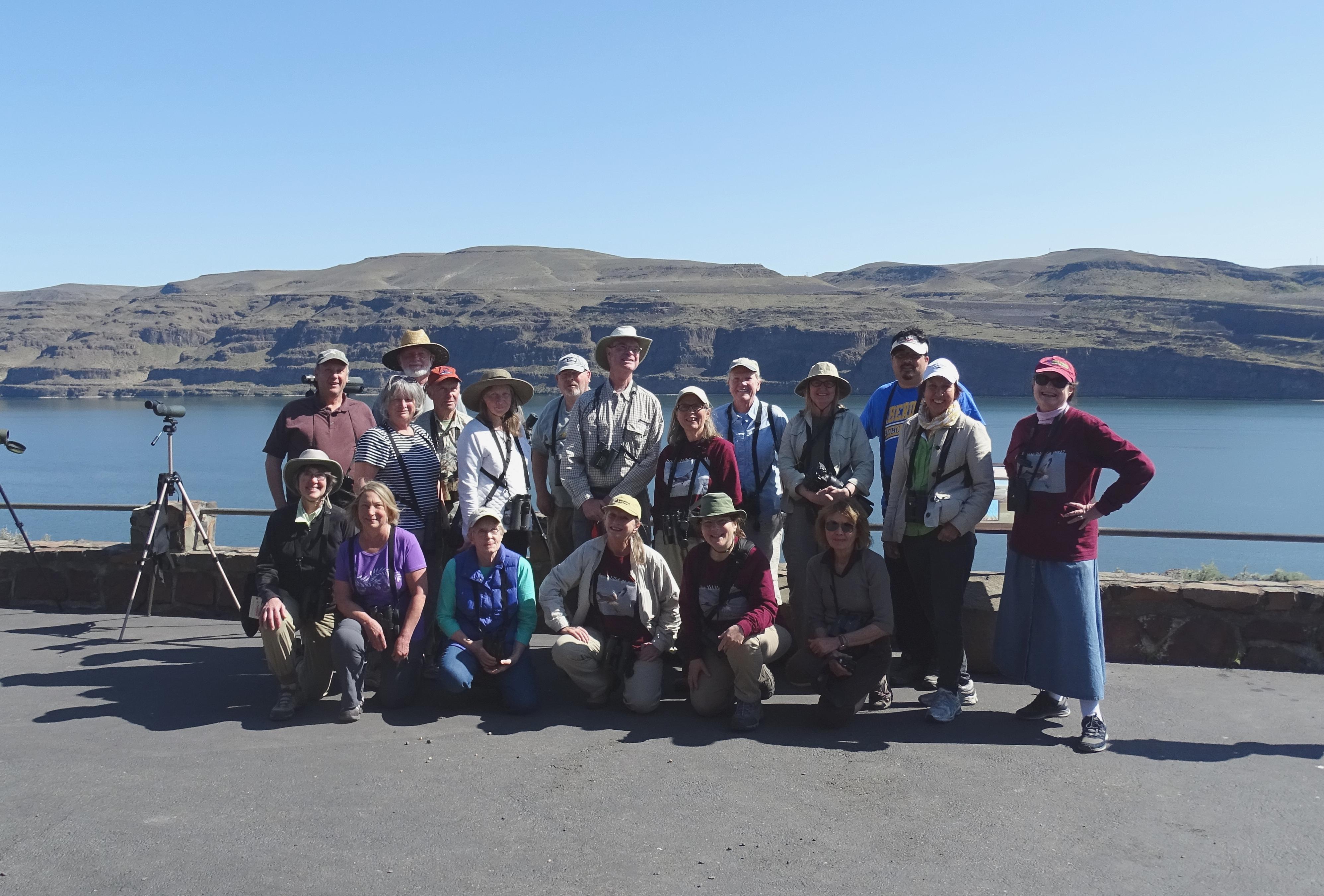
Our ABC group as pictured here at the Ginkgo SP Interpretative Center included:
SITTING: ELLEN STEPNIEWSKI, Petrea, Kathy, Faye, Laurel, Donna.
STANDING: Ken, Carolyn, Richard in hat, Ted, Mary, Mike, ANDY STEPNIEWSKI, Carol, Jody, Heather, Ryan, Kay, Diane.
Shrub-steppe field trip, April 10, 2016.  Taken at Ginkgo SP.

Shrub-steppe field trip, April 10, 2016. Taken at Ginkgo SP.


As an aside, just a couple of weeks ago, the local newspaper did a story on Andy, and it’s pretty thrilling, as well as informative (thanks to Heather for providing the link):
http://www.yakimaherald.com/news/survivor-bear-attack-redefined-how-he-lives-his-life-but/article_d24da4d2-f3e2-11e5-8549-3fbdea3d5b30.html
Salt & Pepper Seabird Spectacle

A SALT & PEPPER SEABIRD SPECTACLE

ABC member Marcus Roening writes:

I had a scheduled trip to Whidbey Island on Monday, April 11, 2016, and elected to take the much more traffic-friendly trip up the west side of the sound and take the ferry from Port Townsend to Coupeville, Whidbey Island. It was a perfect day for saltwater viewing with a high overcast, no wind, minimal wave action and about 3 hours after low tide (or at least 3 hours after the cancelled ferry runs : –) ). The show began while waiting in line, as I watched a pair of Harlequin Ducks diving around the ferry pilings and a flock of Black Brant feeding on the adjacent beach. Once on the ferry, I high-tailed it to the top to get eye to eye with the Cormorants perching on the pilings.

While most of the year the cormorants are variations on brown and black, it is this time of year that they truly shine. The Brandt’s Cormorant can be a show stealer with their white plumes of feathers poking out in fine white sprays on their head, neck & scapulars. But it is when you can get a good sideways look, especially with sun in the background, that you get to see their electric blue gular pouch – truly amazing! And not to be outdone on the same set of pilings, the Pelagic Cormorants were showing off their white flank patches and brilliant dark red face. Heck, even the Double-crested Cormorants were showing their brighter orange than usual gular and their two black wispy crests.

As the ferry continued east, it looked as if some giant pepper & salt shakers had been knocked over onto the Sound. In the middle was a mass of 300-400 dark birds and as the ferry came upon the mass, it was clear that they were Rhinoceros Auklets. They were so close to the ferry, that I could clearly see their white head plumes and their little rhino horns. As I scanned around the mass I realized that there were at least another 400 Rhinos scattered evenly across the water. The human brain boggles at trying to count such numbers and to be in the middle of such a group of at least 800 birds was a very special treat. And that was only counting the ones that were above the water.

Rhinoceros Auklets, April 2016.

Rhinoceros Auklets, April 2016.

And just to keep things lively, there were Bonaparte’s Gulls in their Black-headed finery, Glaucous-winged Gulls with glaucous wing tips, truly “Red”-necked Grebes, Common Murres, Marbled Murrelets and a one group of 63 Pigeon Guillemots working the tidal rip.

It was a great day to be birding.

Marcus Roening, Tacoma WA

ABC April 2016 Sparrow Workshop!

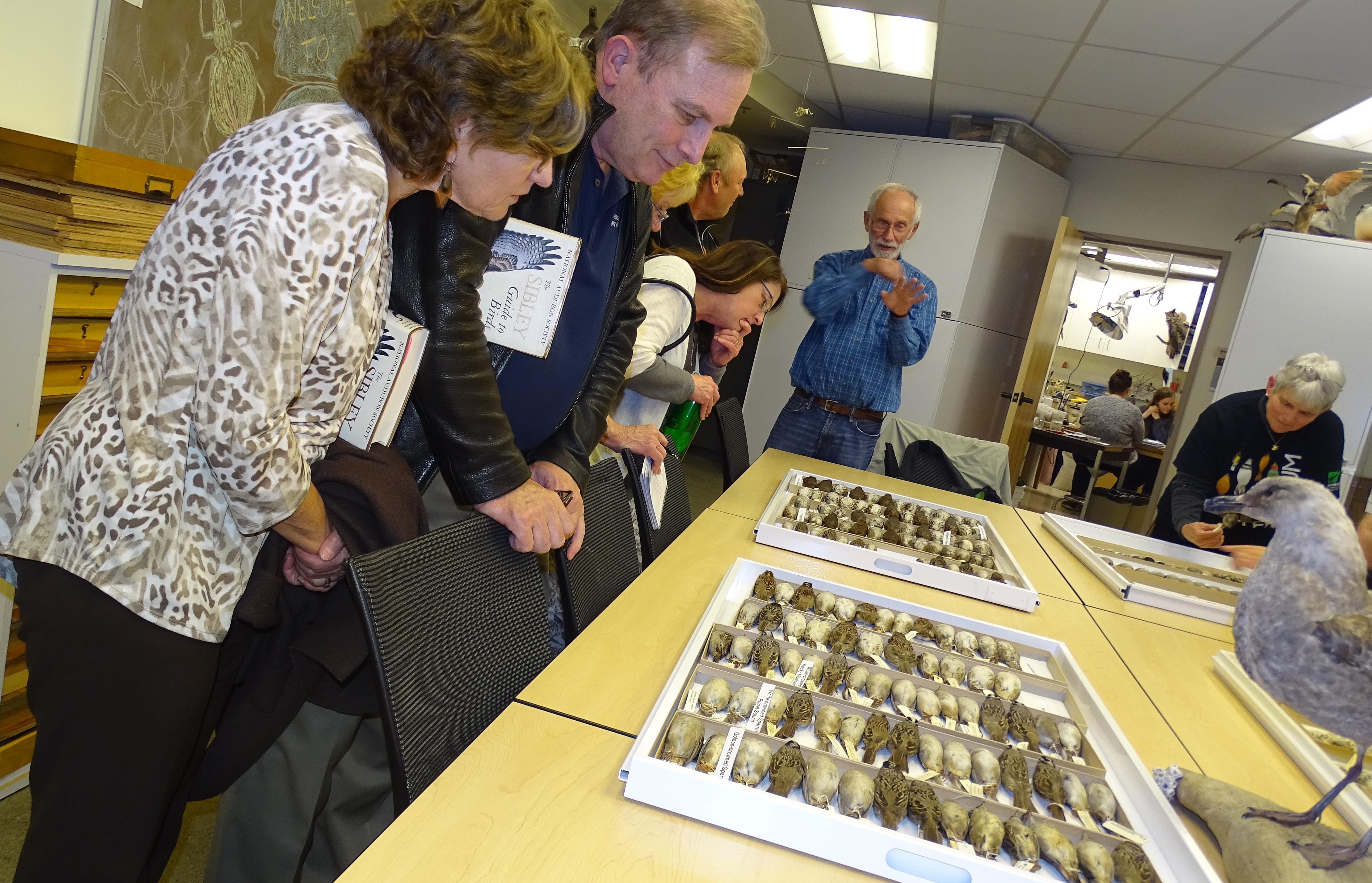
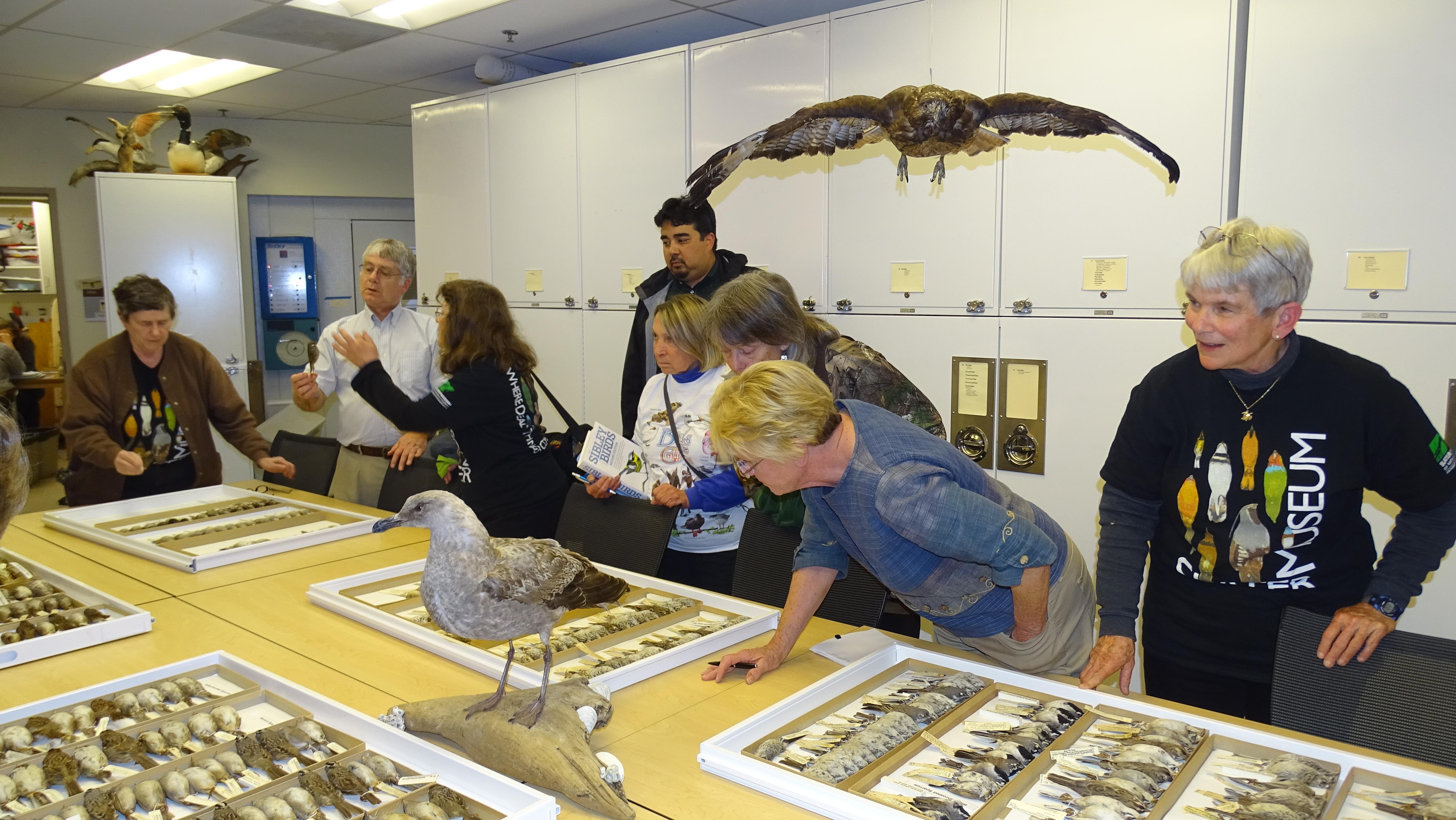
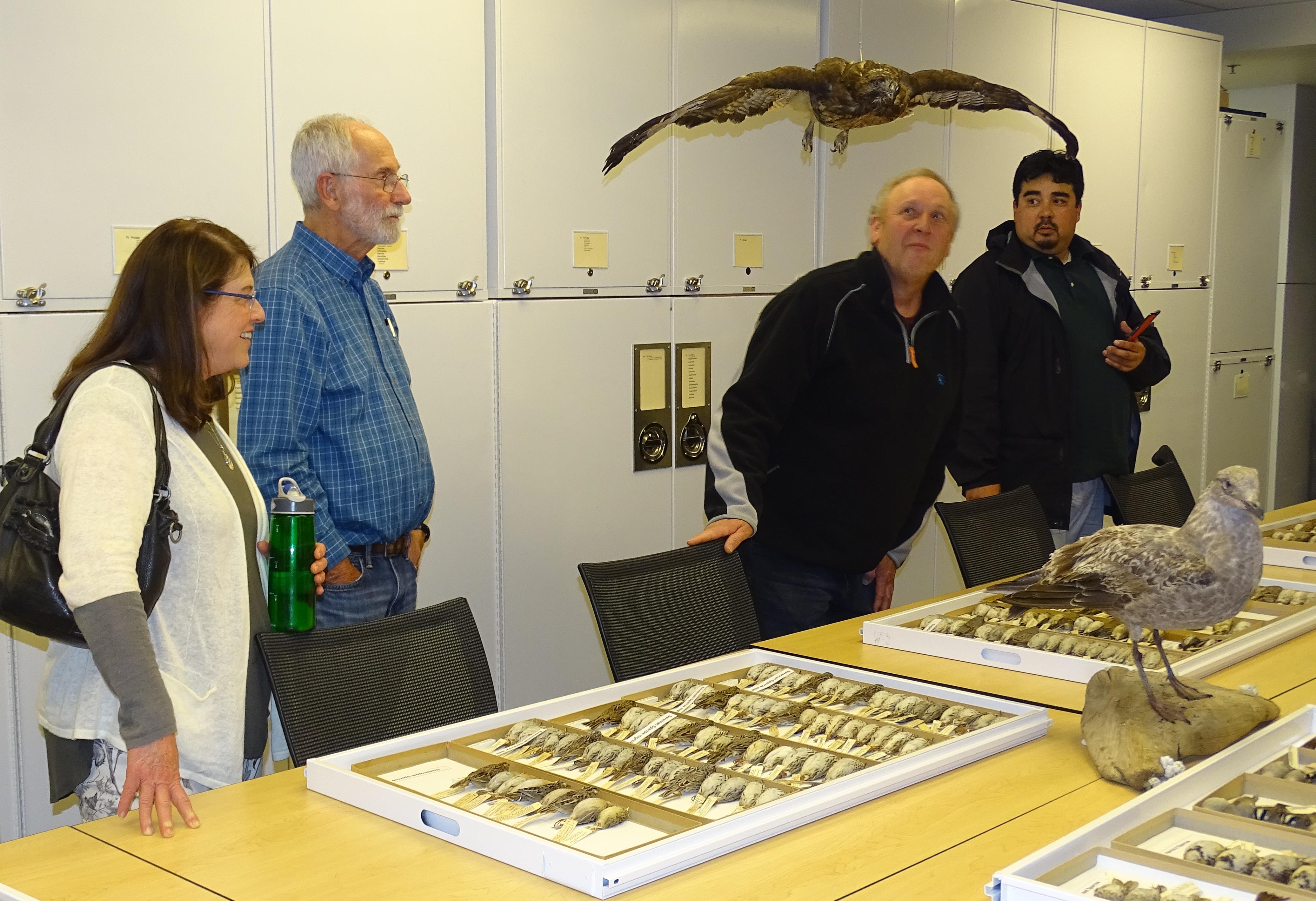
SPARROW WORKSHOP REPORT – April 5 & 6, 2016, with Dennis Paulson.


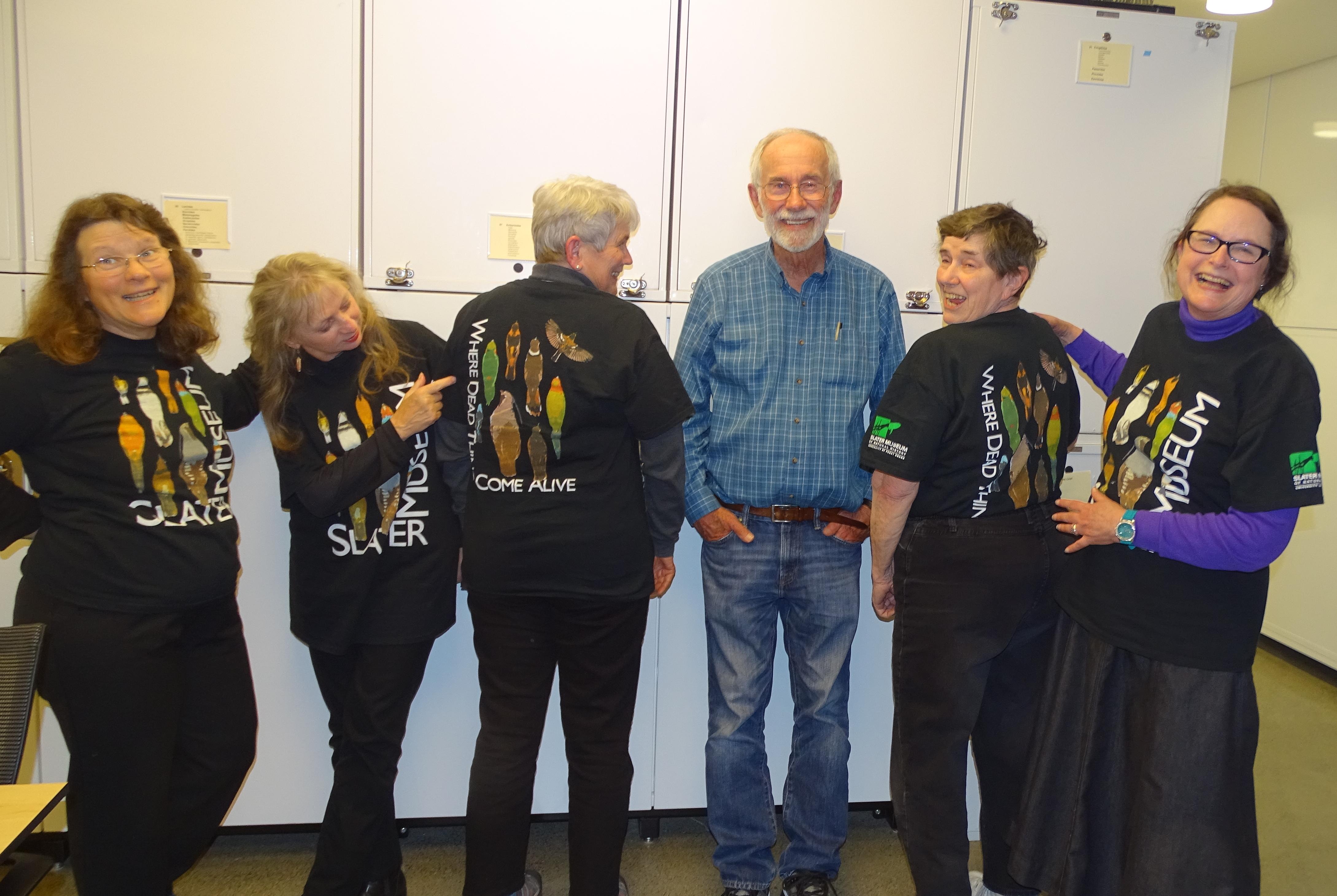
Our mentor, Dennis Paulson, retired director of the Slater Museum, Master Birding instructor, and authority on shorebirds, dragonflies, and everything else that flies, brought ABC’ers up to snuff on LBJs!

DSC04759

Emily and Kevin study sparrows while Dennis Paulson stands by.

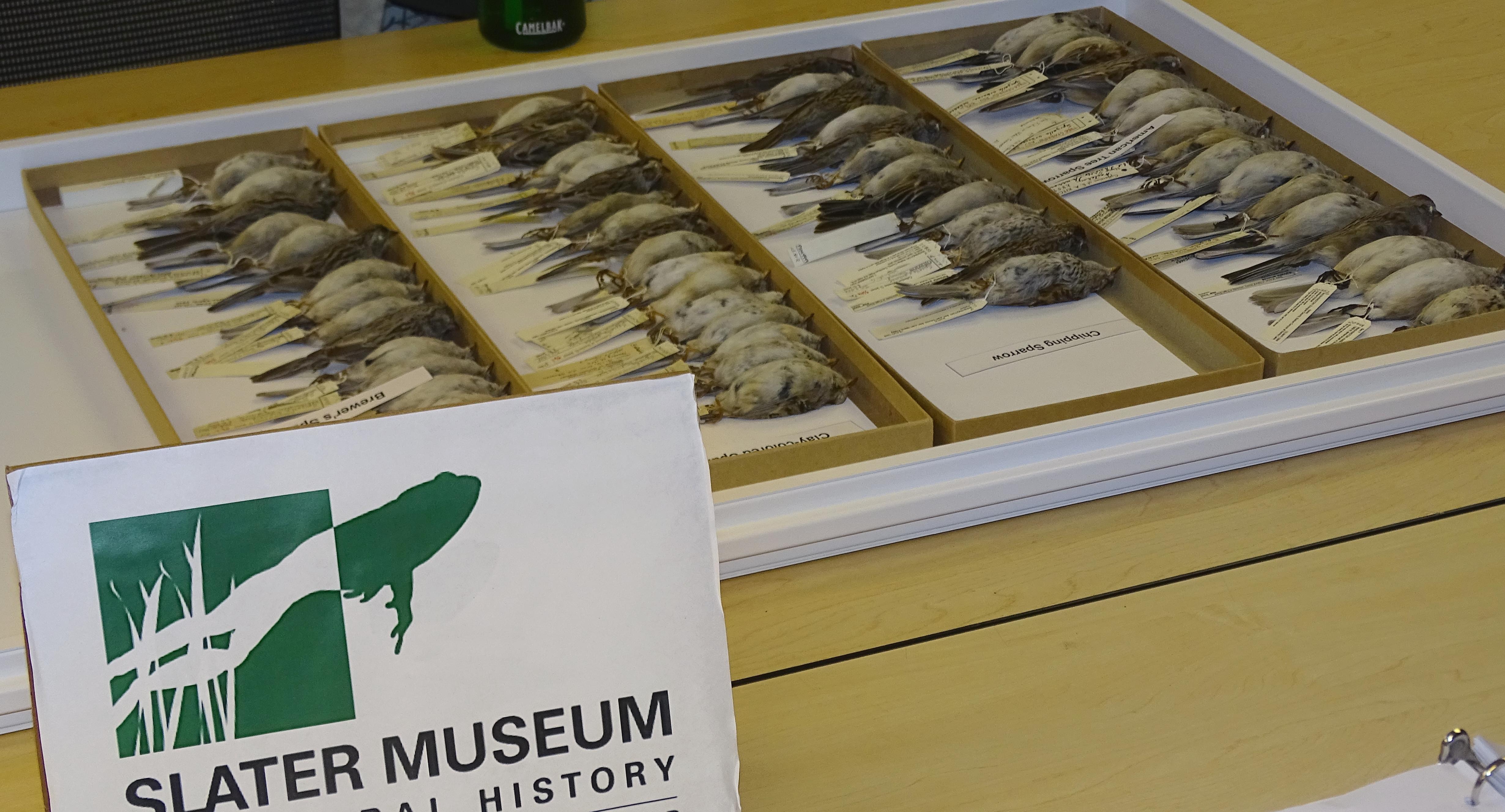
Larus gull dominates sparrows at Slater.

Larus gull dominates sparrows at Slater.

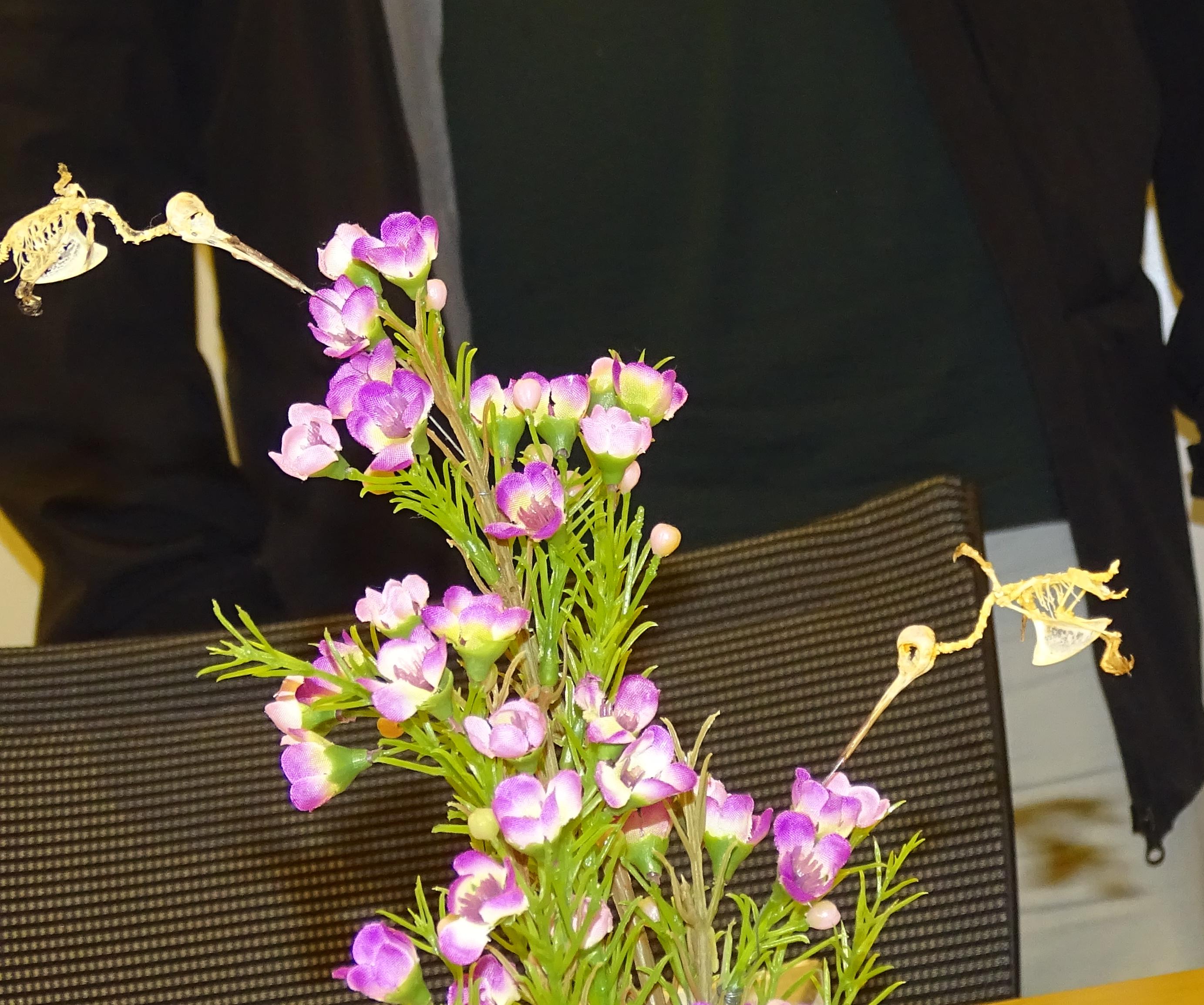
Rufous & Anna's Hummingbird skeletons.

Rufous & Anna’s Hummingbird skeletons.

Margie, our leader Dennis Paulson, Ken Brown, and Ryan Wiese birdwatching.

Margie, our leader Dennis Paulson, Ken Brown, and Ryan Wiese birdwatching.

Dennis Paulson surrounded by Slater Museum groupies.

Dennis Paulson surrounded by Slater Museum groupies.

Sparrows!

Sparrows!


Some interesting factoids included:
ANY sparrow can have a breast spot, not just those who are supposed to.
That rufous on a Vesper’s wing is at the WRIST, in cast you thought that was the shoulder.
Sagebrush Sparrows run around like mini Roadrunners.
A notched tail can look square, then round, as the bird spreads it.
Fox Sparrow subspecies leapfrog each other in migration patterns.
Most birds that live in thickets cock their tails, including many sparrows, not just wrens.
Chipping Sparrows are the only sparrows that migrate in juvenile plumage.
Yes, Juncos are breeding more on the west side than in time past. It’s not just your imagination.

After the classroom instruction, a fun time was had by all in the museum, noticing how tiny the specimens were and how different Song Sparrows are compared to Lincoln’s Sparrows, as opposed to living birds. A few non-Sparrows were also admired, such as the hummingbird skeletons and the Bat Mobile.

Thanks, Dennis. You can be sure we’ll be after you again for more instruction in the future.

February 2016 meeting – Ecuador birdbanding!

ABC FEBRUARY 2016 MEETING REPORT:
LIFE NET NATURE/Ecuador:

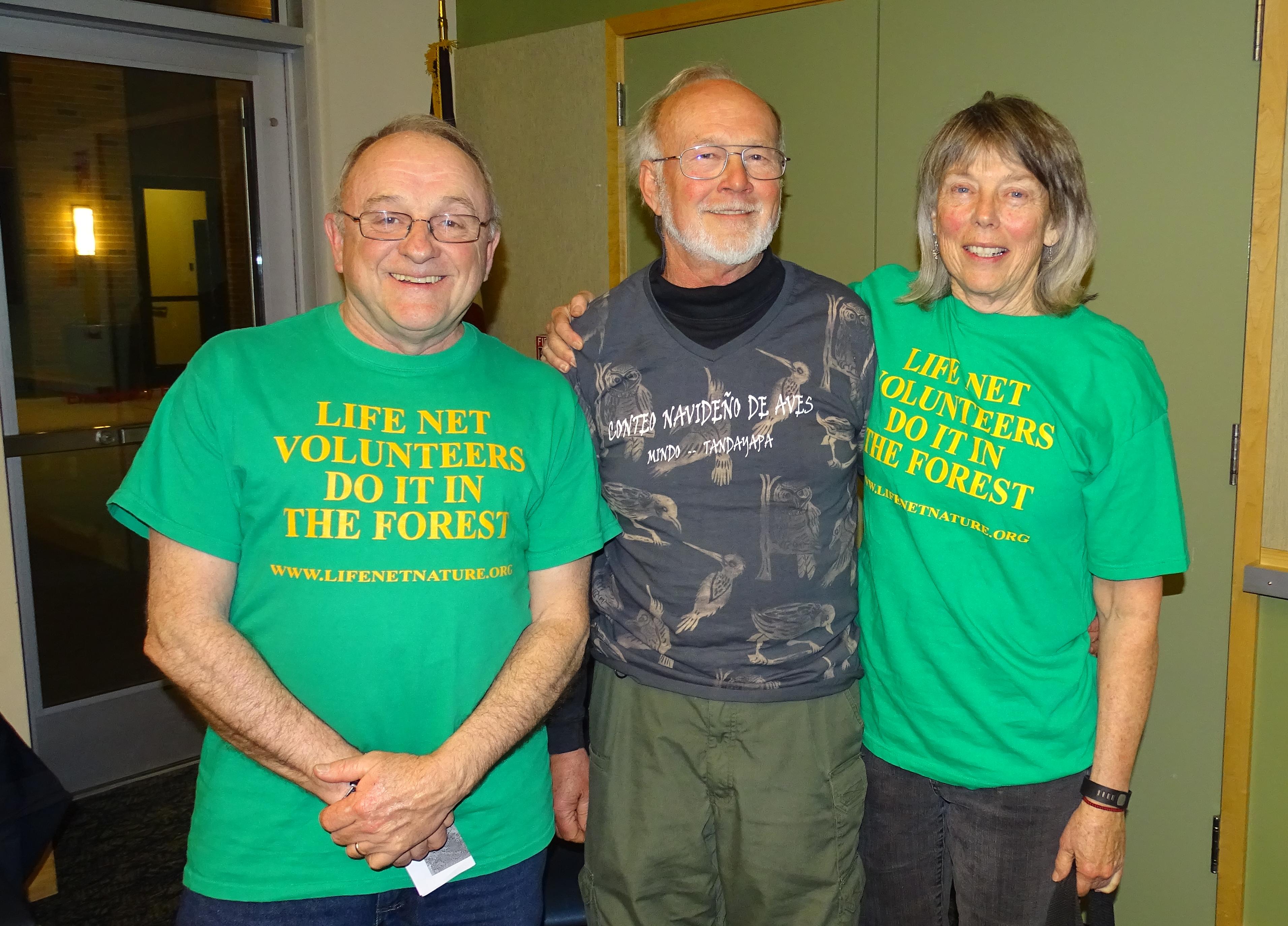
On February 16, 2016, ABC’ers were entertained and educated by three of our own, Mike Walker, Jerry Broadus, and Clarice Clark, on their experiences banding and otherwise counting birds at the Life Net Nature site in Ecuador at the Las Tangaras (Tanagers) Reserve in the tropical Andes. The group was so thrilled that we practically had to be kicked out of our room at the library or we would have been there all night.

Mike Walker, Jerry Broadus, Clarice Clark - our team in Ecuador

The history of this reserve, one of several throughout the world administered by Life Net, is another example of one person making a huge difference in the knowledge deficit surrounding tropical birds, this person being the founder of the reserve, Dr. Dusti Becker. Just a few days of observing and banding in this reserve almost always turns up something previously unknown to science.
Mike started out with this history, which he knows well, having done 5 volunteer stints there by now. He was definitely recruiting for the next December period. This last time there were 7 volunteers besides the staff, and his map showed the ABC Team (3) plus 2 from Utah and 2 from the east, so only 7 people. Mike made it sound like Paradise, which perhaps it is, with great food, luggage carriers (burros), and a swimming waterhole. The lodge must be hiked into, so not a lot of riffraff. The swinging bridge wasn’t loved by all (Clarice!), and the barracks sleeping quarters weren’t like the Hilton, but running water, occasional electricity, clean air, and the music of the jungle. Volunteers pay $1650 from Quito for 2 weeks all inclusive, part of which is fundraising, but anyone who’s priced birding in this area will recognize this as a darn good deal.

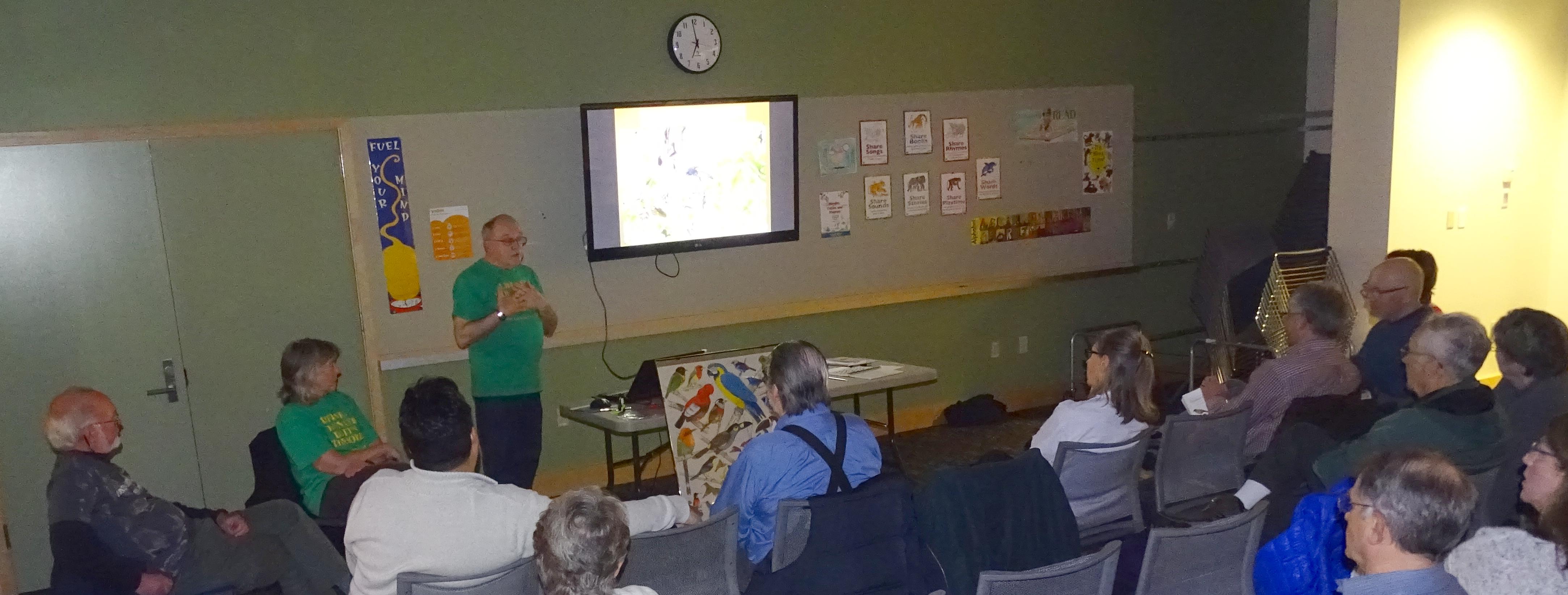
Mike addresses the ABC'ers
The forest was so dense that it was hard to see birds, but the huge network of mist nets turned up amazing finds that would never have been seen just with binoculars. The photos were great and were taken by our team, either at Las Tangaras or nearby afterwards.


A crowd pleaser was the Andean Cock-of-the-Rock, which the team got very acquainted with via photos and videos of lekking males. Wow! Not a really melodic dawn chorus, though!
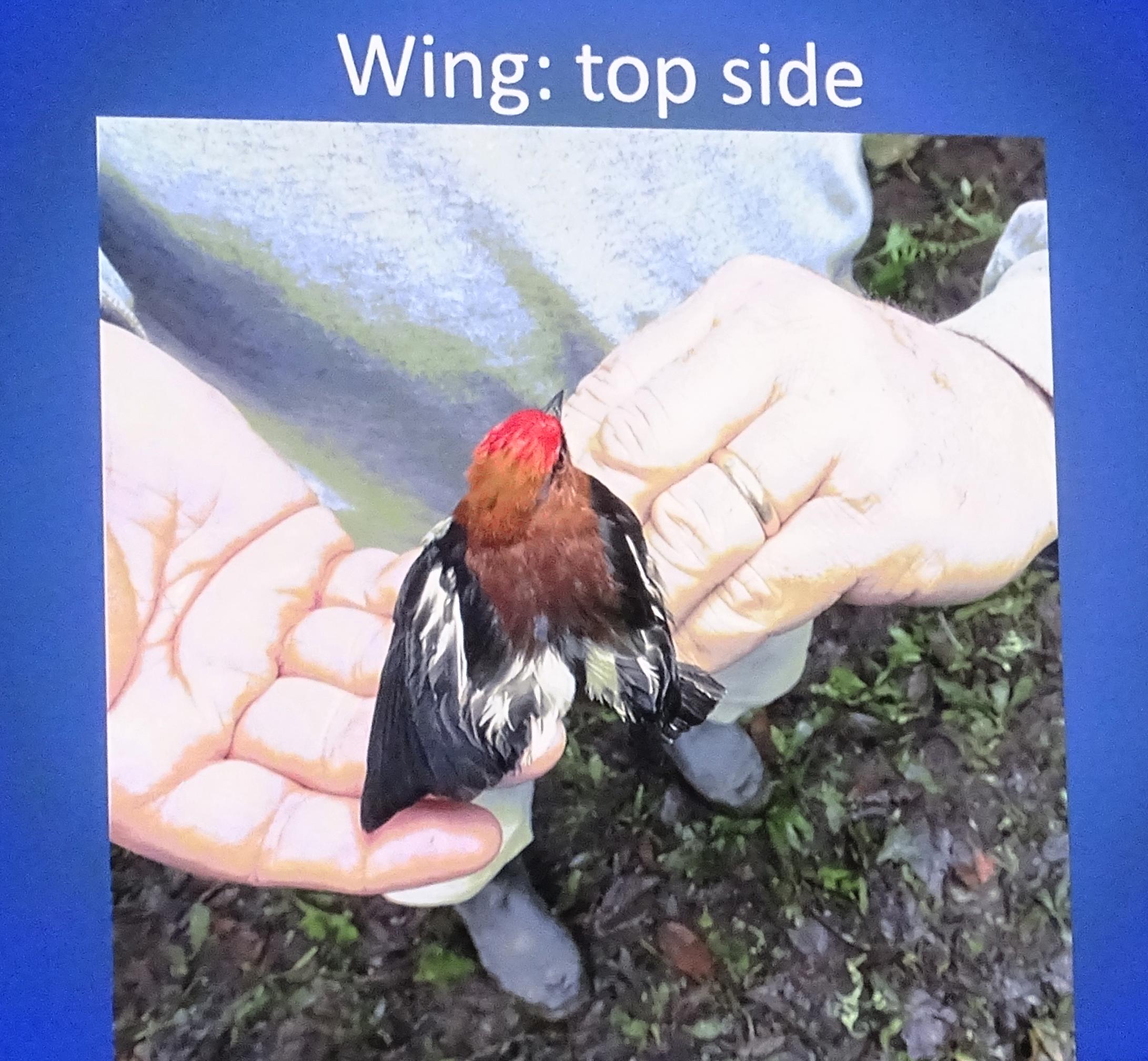
Jerry led us through the banding process including the amazing Club-Winged Manakins, which they were able to both examine in the hand while banding plus get video of that amazing wing-slap sound!

Club-Winged Manakin
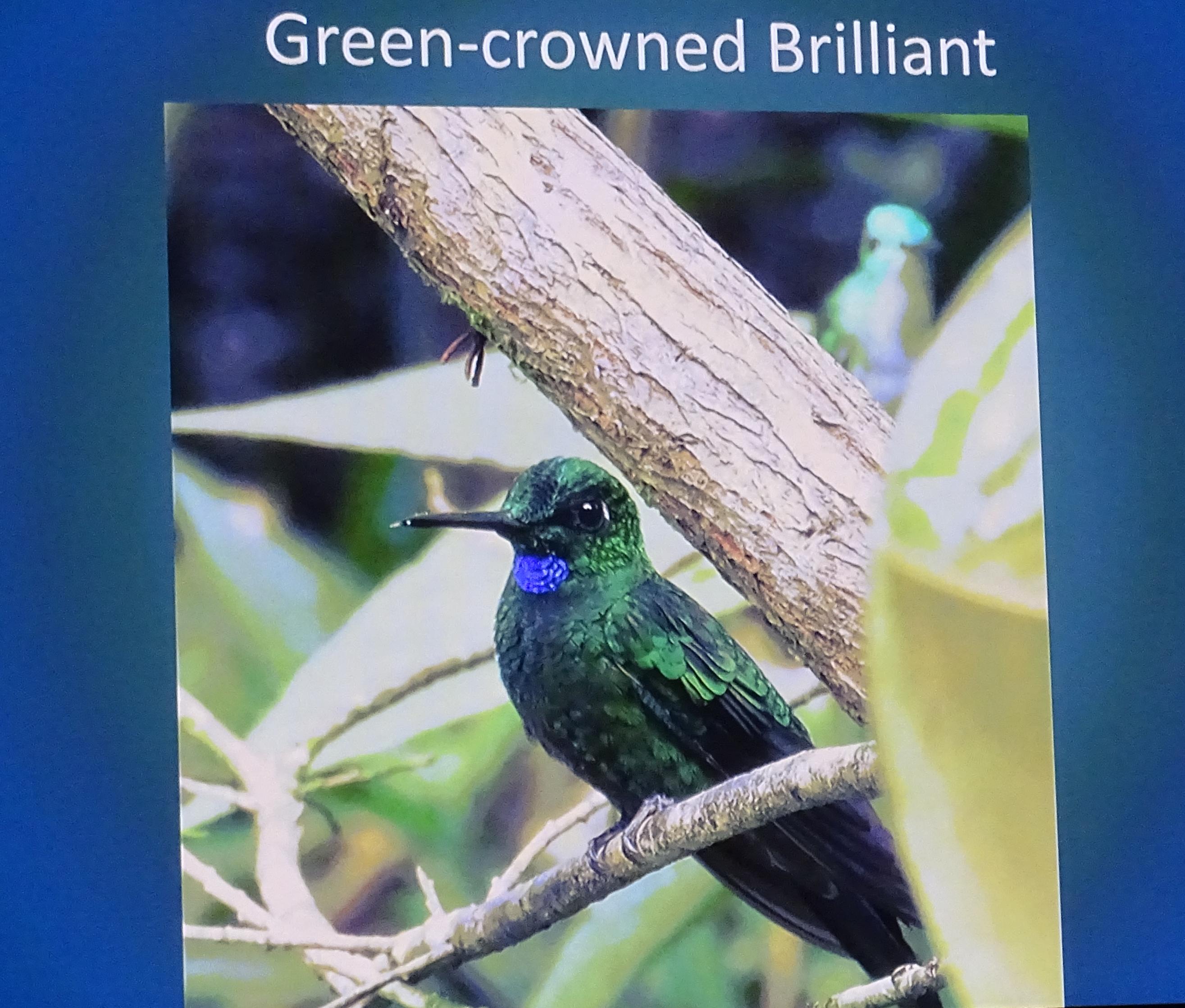
Clarice ended the presentation with the dessert — Hummingbirds! There are so many species (30+) that in short daily counts watching 3 feeders, the team relied on cheat sheets. Some were caught for banding in the mist nets, but most of the banded hummers were caught with a feeder trap. One of the miniscule bands was passed around for the group to see the size. Attaching these to the tarsi of tiny birds was a painstaking and even scary process.

Green-Crowned Brilliant
The website for the organization is currently not working well, although if you persevere and scroll to the bottom you can find most of the meat about the projects and how to volunteer:
http://lifenetnature.org/index.php/volunteer/andes-mountains-south-america/
Also: https://lastangaras.wordpress.com/who-are-we/

April 10, 2016: Yakima County FT with Andy Stepniewski

APRIL 10, 2016:  Yakima County with Andy & Ellen Stepniewski!  

Washington’s Shrub-Steppe and its Birds: 
Sunday, April 10, 6:30 am – 5 pm.
Join Andy and Ellen Stepniewski, both birders and naturalists, for this program for the ABC Club on Sunday, April 10 in Ellensburg at 6:30 am.   Andy authored “The Birds of Yakima County, Washington” and writes a monthly nature column called Wildlife Moment for the Yakima Herald-Republic. Both Andy and Ellen are active in the Yakima Valley Audubon Society.
It’s easy for folks living in the cool and moist west side of the Pacific Northwest to be unaware of the opposite world on the other side of the Cascades in the Columbia Basin. In the west, one is seldom far from water and the Evergreen State does seem apt.  East of the Cascades, water is scarce and precious and the countryside is often more gray than green. Trees are replaced by a cover of shrubs and grasses. This ecosystem is called the shrub-steppe. Think of eastern Washington’s Columbia Basin as high desert with sagebrush and grasses. Ecologically, it is a part of the Great Basin, that vast region of the American West lying in the rain-shadow of the Cascade and Sierra Nevada Mountains. The shrub-steppe landscape is indeed very different from western Washington’s moist conifer forests.
Andy spoke to ABC a year ago about this area.  A short report can be found on our website at:
FIELD TRIP ITINERARY:
Meet at 6:30 am at the Buzz Inn Steakhouse at Exit 109, just south of I-90, and north of the truck stop. From there we caravan out on I-90 to Exit 115 and head south, first touring ag fields for curlews and hawks. Then, we head east along the Old Vantage Hwy, stopping in the Quilomene WA to view and hear shrub-steppe birds such as Sage and Brewer’s Sparrows and Sage Thrashers.
We press on east and down the old highway to Vantage, perhaps stopping a few times to search for owls and shrikes.
At Vantage, we’ll gather at the Gingko Interpretive Center overlook and search for Rock Wrens and Say’s Phoebes, as well loons, grebes, and diving ducks on the waters below.
From Vantage, we tour south along Huntzinger Rd., searching for Great Horned Owl, swallows, Canyon Wrens, and White-throated Swifts. We’ll also admire the stupendous cliffs at Sentinel Gap, where a Peregrine might rocket by.
From Vantage we head across the Columbia River and go east along Crab Creek below the magnificent Saddle Mountains, amidst a landscape very similar to many mountain ranges to the south in the Great Basin. Raptors, shorebirds, and huge flocks of Sandhill Cranes are possibilities.
Return to Seattle via SR-26 to I-90 and thence west over the pass.
Field Trip limited to 5 cars total 20 people including trip leaders. 18 spaces available.
6:30 am meeting at
Buzz Inn Steakhouse
2202 Canyon Road
Ellensburg, WA 98926
Call or email Diane to sign up, Avosetta@hotmail.com, (253) 857-3367.