Spring Class Notes 2010 – Class 1

I thought as the peak of spring migration is just around the corner it is timely to put up notes from a previous spring class.  The most recent relatively complete notes I have is the 2010 spring class, as in 2011 I just listened and used old notes.

4-20-10 Class #1 Spring

Field Trips:

This class will be more of an impressionistic class

Bring the shorebirds molt and voice worksheet to class each time.

Strategies for molt.

Simple basic- start in juvenile, go a year in juvenile, then have one molt annually into a basic plumage.  (like hawks)

Complex basic:  juvenile à formative plumage, the annual molt into basic plumage. (like towhee)

Simple alternate:  juvenile à pre alternate moltà pre basic à …  (like loons?)

Complex Alternate: Juvenileà formativeà pre-alternateà pre basic à pre alternateà …  (like most songbirds)

Pre-basic molt is complete, all feathers.

Pre-alternate molt is incomplete, usually not flight feathers, other feathers vary by species.

Short distance migrants molt on breeding grounds or in staging areas.  Long distance migrants may start molt on breeding grounds, then suspend the molt, and finish on the wintering ground as they cannot both migrate and molt simultaneously.

Birds have a complete molt in the fall

Birds have an incomplete in spring into alternate head, body, all scapulars, and maybe some wing feathers.

Terms used to describe the extent of a molt, usually the pre-alternate molt:

Partial:  head,  in spring into alternate head  body, few covets and some scapulars

Limited:  in spring into alternate head and a few body feathers

These are the common Western WA shorebirds you should know for our upcoming trip.  BBPL, both yellowlegs, dowichers, dunlin, Least SP, Western SP à plan to know these by voice  before the coast trip.

A Shorebird year starting Jan 1:

As early as Jan and as late as June, shorebirds are entering pre-alternate molt.  By the time shorebirds get to WA the adults are usually in full alternate plumage.  Most juveniles stay on wintering grounds, but some young birds may migrate in their basic plumage and others of the same species may have a PA molt into an adult or near adult alternate plumage.

The migration thru WA is in a rush, usually in late April- early May.

Adults usually nest as soon as they get to breeding grounds, usually in mid may to early June.

Failed breeders and some young birds almost immediately head back.

Young birds are in downy plumage for about a month and then go into juvenile plumage.

First after failed breeders back are females in worn plumage, followed by males in worn plumage a week or so later.  Then a week or two later, or sometimes much later, are bright fresh juveniles.  Going on their own,  at 1-2 months of age.

PB molt in some adults can start as a limited molt even on the nest, or on the breeding ground.

Suspend molt of remiges (flight feathers in spring into alternate head) and rectrices (tail feathers) until on or near the breeding ground.

On wintering grounds birds finish their wing and tail molt.  Those who winter in NA may finish their molt at stopovers.

Juveniles start their PB 1 molt somewhere between Sept and Oct and end by Dec.  This is a formative type plumage, incomplete in most species vs. adults having a complete molt into basic plumage.

Impression:  Next week come prepared to concisely discuss whatever bird we are identifying.

As a homework assignment do a walk or go into back yard and bird by ear and without binoculars.  Use GISS not binos.

We will also work on expected location, time of year, habitat, behavior, relative size, etc.

We will look a lot at structure, legs, bill, neck, wing and primary projection, head structure.  Look at feeding behavior, voice.

Last we will look at plumage impression.  White belly dowicher is short billed, long billed don’t have white bellies.

Dunlin grayish with a dark breast, Western SP brownish above with white breast.

Get a copy of the Howell Shorebird guide. Much of Ken’s comments are there and so you can avoid the need to take so many notes.

Molt:

Remiges and Rectrices:

Primaries numbered 1-10 and molt begins on the innermost primary (1) and moves outward.  Secondaries are numbered outward to inward, and so P1 is beside S1.  Secondary molt begins after primary molt is about half way done.  It moves from outside in.  This results in gaps in the wing feathers.  If you see these gaps it usually means the bird will molt in NA.  Some birds molt at staging grounds (like LBDO)  vs. SBDO does not molt primaries until on the wintering ground.

IN spring you see nice fresh feathers on the head, scapulars and the bodies.  Fresh feathers have nice well defined patterns, and old feathers have the fringes and patterns on the edges worn off, sometimes serrated or saw tooth edges.  Dark pigments wear tougher, lighter feathers wear faster.

Juveniles have usually white edges on scapulars and coverts.

Old feathers tend to look frayed on the edges and can droop more, not as stiff.   As they droop more they eventually fall out.  Old feathers tend to be more pointed as they wear, more rounded when they are fresh, and as they wear off the white or buff rounded edges they become more pointed.

Good example of feather wear is the Least Sandpiper.   In spring highly patterned with light tipped feathers,  very patterned.  When they come back in the fall they are darker with less patterning on the top.  In August you will see fresh juveniles, and worn adults. Later the juveniles will look more worn, and the adults are going thru PB molt and will look much sharper and fresh.


Species accounts:

Black bellied Plovers:  all year have black axillars, wing stripe, the biggest plover, blocky, on mud flats, on open beaches, roost on upper beach, golf courses.  Upland species also. More west, but also E of Cascades.  3 syllable loud  plaintive   Plee-uu-ee lower in pitch than golden plovers.  Up until PB2 molt you can age juveniles by their worn primaries.  Especially in spring.  Listen for calls in flight.   GISS, chunky, thick necked, heavier bill than golden plovers, note 240 gm vs. 130-140 grams for goldens. Seen spring and fall.

Pacific Golden Plover: lower pitched, emphasis on second syllable, variable pitch  mostly seen in the fall. Buffy, In spring white on flanks, appear to be front heavy, look like they could tip over forward, larger head, rounder body, stand taller, shorter wing projection and longer primary projection of 4 feathers.   Have a molt that does not include the primaries.  So in the springtime look at the primaries, and in first year pacifics have worn primaries all the way until June or July, so very worn.   So if you see a golden plover in spring with worn primaries it is Pacific.   Pacific adults molt the inner primaries on the breeding grounds (Americans do not)   So inner 5 primaries will be fresh in adults in migration in fall.

American Golden-plover:  In spring stripe ends before the flank, more slim, more attenuated, not as plump, longer primary and wing projection.   No wing stripe. Dark tailed.    One tone note, two syllables.   Have a complete fall molt, between Oct- Dec. includes the primaries.   First year Americans have fresh primaries.  In migration American GPs do not molt their primaries until on the breeding grounds.

Mountain Plover:  pale all over, big headed, thick necked, short grass or plowed fields, loose flocks.

Killdeer:   slim, long tailed, small bill.

Snowy Plover:  drrrp toor-eeet  call.  Light plovers with dark legs and dark bills, longer and slimmer than semi-palmated, tend to be front heavy.

Piping Plover:    two tone bill, orange legs.  More attenuated, not front heavy, tiny bill. 

Wilson’s Plover:  light legs, dark above, larger and front heavy, large head and bill, thick bill.  Usually on upper beach.

Semi-palmated Plover:  two syllable note, chu-eep.   Come through very early in the fall, often in July.

Black Oystercatcher:  Bulky, short thick neck, long thick bill

American Oystercatcher:  southern coasts, sandy beaches, two toned, also mud flats.

American Avocet:  Alkali ponds, E WA, rare in migration on W side, larger than black necked stilts. Chunky.  Loud PLEET CALL.  Gather in large groups to molt in migration in fall.

Black-necked Stilt:   slim body, long legs, needle-like bill, alkali ponds, very rare in migration on W side.  Yip-Yip-Yip loud call

Greater Yellowlegs:  higher more strident 3 noted call    Two times the weight of lesser, long upturned bill, look like they have an Adams apple, bulge on front of the neck.  Pick and chase.  Scurry around the pond.  Seen all year round, numerous spring and fall.  Pattern above and stripes on upper neck.

Lesser Yellowlegs:  slim-chested, smooth body contour, straight bill, more methodical scything movements as it walks, usually does not run.  Walks steadily.   Unusual  in spring, either E or W side.  Usually fresh water ponds.  Seen as early as July 1 in fall thru. Sept.  rare after September.
A Plea For Help at Grays Harbor

Date: Thu, 12 Apr 2012 14:03:22 -0700

ABC Birders: 

You can help with this!

Dear Birder Friends, 

For the past 10 years, we have been working with students in Grays Harbor County providing a series of classroom presentations about shorebirds and shorebird conservation. The finale of our time with them is a field trip to Grays Harbor National Wildlife Refuge to see shorebirds during the spring migration. Volunteers help during the field trips and provide needed assistance with helping kids see and identify birds. This year, we are very short of our usual volunteers so I am reaching into my personal pocket for birders I know that might be willing and able to help out.

We have field trips scheduled for the following dates: April 17, 18, 19, 20, 23; May 1, 2, 3, 4, 7.  They are mid-day either starting or ending around noon. The buses drop students off at the Sandpiper Trail and the students, with parent helpers and teachers, walk down the trail. They spend about an hour in the shorebird viewing area of the boardwalk before leaving. The students all have field journals and some teachers will have the students bring them to work on. We have some binoculars for students, also. The students are 3rd and 4th graders. This is an underserved population of kids and we consider this environmental education program a very high priority!

We would love to have YOU in the prime shorebird viewing area, with a scope, helping kids see and learn more about the shorebirds they have been studying. Would you be willing to help? If so, please contact me with your availability and we’ll provide the specific times. 

Thank you in advance for your consideration of this request!

Posted for Diane  Y-Q

Opportunity to explore Tacoma Rifle & Revolver Club

From Bill & Noel Hagens, our field trip chairpersons:

Krystal Kyer, the Tahoma Audubon Executive Director, had a visit from Duane Hatch, the President of the Tacoma Rifle and Revolver Club in University Place near the Chambers Bay properties. He is also an Audubon member. He is interested in having either a field trip or a birder come out and survey the property, which has about 70 acres of forested area with some primitive trails behind their range. Bill would like to pursue this idea and wonders if one of you might be interested in meeting Duane and Bill to survey the area initially and possibly lead a field trip out there sometime. Thanks! Noel and Bill Hagens

HELP!! Swift Counters needed at JBLM-Fort Lewis now!!!

Advanced Birders — Here is a call for help that surely some of you can answer!!

Spring migration is about to happen at Vaux Swift chimneys, and we have a treasure here in the south sound at the fort! It is very exciting to count swifts funneling into a chimney, and it takes less than an hour on the appointed evenings. Counting guidelines will be provided plus some expenses (see below), but we need people SOON!!!!

Contact swift expert larry Schwitters (leschwitters@me.com) or Burney Huff (burney.huff@mindspring.com) for more details. See below. you can also contact our own Rolan Nelson who has been a counter there in the past at rnbuffle@yahoo.com to find out what’s entailed.

This is a fabulous chimney, largely unknown to the birding community until recently because of its inaccessability on a military base. Help make it famous! It is, however, extremely well known to Vaux Swifts who visit by the thousands.

Diane Y-Q Avosetta@hotmail.com

> From: leschwitters@me.com > To: Avosetta@hotmail.com > Subject: Vaux’s Happening at JBLM > Date: Mon, 2 Apr 2012 11:38:57 -0700 > > Hi Diane, > > I hope that you’ve not just survived but thrived in the “off > season”. I’m afraid we are back to needing help at JBLM. Burney > Huff did an amazing job of getting an almost nightly count last > migration. He did it with a small number of people, but is not going > to have his number two any more. For this migration only we have a > milage reimbursement and Burney can help with the pass onto base. > > If we can get good data I’ll be able to nominate it for an IMPORTANT > BIRD AREA. This is not an easy one and I know you don’t live close by. > > Larry > > Larry Schwitters > Project Coordination > Audubon Vaux’s Happening > > vauxshappening.org >

East Side Field Trip April 14 – 15

Hi Folks:

I’m organizing a field trip to the East Side to look for Sage Grouse and other sage nominate species. The trip will be from April 14 – 15. We will meet at the Snoqualmie Pass Traveller’s Rest @ 8:00 am on Saturday, 14 April. Spending the night in Grand Coulee.

The general outline is to try some new areas including Beezley Hills and Moses Coulee on Saturday. If time allows, we’ll head off to Wilson Creek, then overnight in Grand Coulee. Sunday will be early, since we must arrive at the Leahy lek site by sunrise. I scouted the lek on March 24th and saw 21 Sage Grouse, including 18 males. The only good thing about getting up that early is leaving plenty of time on Sunday to bird our way back. Possible destinations include the upper Moses Coulee, the Bridgeport area and Badger Mountain.

Please email me at rwiese@wamail.net if you’re interested.

Thank you,

Ryan Wiese

Gull Identification Trip with Charlie Wright and Ken Brown

A group of 11 ABC birders joined Charlie Wright and Ken Brown on a gull study outing in south King and Pierce counties on what started as a very rainy Saturday, but ended up with some unexpected but much appreciated sunshine at the log booms in Tacoma.  Ken plan the trip to begin in Pierce County and move to King County in the afternoon but because of the heavy rain in Pierce County in the morning we instead went directly to the Gene Coulon  Memorial Beach Park on Lake Washington where we could bird from the cover of the cupola there.  As was the trend for the day we didn’t find large numbers of gulls but enjoyed careful study of what we did find.

For me one of the highlights of the day was having Charlie show us how to use the new iPhone and android app Bird’s Eye Birdlog NA. Using this app it’s relatively easy to log the time you start birding area enter the species and numbers of individuals seen and then submit the list thereby ending the time at the site directly to your E-bird database. For me I’m hopeful that this app will give me incentive to keep better records and lend my tiny support to this tremendous resource for birders.

At Coulon Park we didn’t have large numbers of gulls but got excellent views of all three age groups of Mew Gulls as well as five Glaucous-winged gulls and a Glaucous-winged by Western hybrid. The small number of gulls may have been in part due to the second cycle Bald eagle that flew in and roosted on a post right in front of us.

Our next stop was at the Foster golf links in King County near the Yellow Truck company lot and the BECU headquarters.  Although large numbers of goals are seen here at times we pretty much struck out seeing just one Mew Gull and a single Glaucous-winged Gull. From here we stopped at the Tukwila gull spot where our luck remained about the same. After struggling to find gulls in King County were decided to return to Pierce County and our first stop got us off to a better start at the McDonald’s near the tide flats. There we had a Western gull along with a few hybrids and a single Glaucous-winged gull.

Things were starting to look up as the rain was diminishing nicely and from there we spent the bulk of the day at the Gog-Li-Hi-Ti wetlands. Gulls were present in modest numbers but excellent variety. Charlie and Ken both noted that unlike midwinter when a nice flock of adult Thayer’s gulls is usually present the majority of the Thayer’s gulls we saw there were first cycle birds with a few second cycle birds mixed in and far less adults than is seen in midwinter. The stop was an excellent opportunity to study molt and a good number of most of the common gulls in various age groups. We added Herring gull and were all pretty much blown away that Charlie identified both of them in about a millisecond on-the-fly. We used Ken’s tried-and-true technique of teaching with Charlie leading the way starting on one edge of a ridgeline and moving through the individual birds and talking to us about their identification and usually aging the birds as well. I think all of us came away at least a little bit better at gull identification after this exercise.

Next we were off to the Port of Tacoma the end of Alexander street where from the parking lot we picked up our first Bonaparte’s gulls of the day fairly far out on the water, some of which were coming nicely into their alternate plumage. It was fun to see my first black headed gulls of the year and most of us saw our first Caspian Tern of the year too. We also got to study a first cycle Least sandpiper and got a good laugh at Ken’s reminder that it had three ages of feathers noted, it’s juvenile primaries were looking pretty worn. It  was mostly in its formative plumage with a few first alternate feathers noted on the mantle and back.  One more opportunity to study molt, of if you are Diane to stay away and cover your ears.

Last at the log booms on Marine view Drive we had sunshine.  As we marveled at  getting a break in the weather on the latter half of our day we also got great looks alternate plumage Brandt’s cormorants, added a variety of other water birds tour day list and tried for at a seventh species of full for the day but we the hoped-for California gull didn’t materialize.

All of us are grateful that to Charlie for bringing fresh energy and tremendous expertise to our study of gulls and of course to Ken for his continued tutelage and great trip-leading skills. I hopt to see you all of at the next ABC meeting.

MEETING/CLASS REPORT

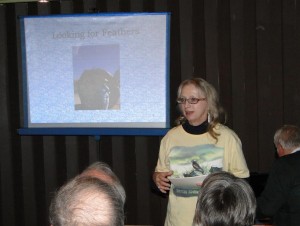
March 22, 2012: “Faye’s Feathers – A Search for Meaning in Feathers,” presented by member Faye McAdams Hands. A report on feathers — all aspects! You may be tested! Much of her info was gleaned from the new book, “Bird Feathers,” by Scott & McFarland, whom Faye and fellow Willette Carol Smith had a chance to meet and chat with. Book is available at Tahoma Audubon or Amazon  (http://www.amazon.com/Bird-Feathers-American-Species-Ornithology/dp/0811736180/ref=sr_1_3?s=books&ie=UTF8&qid=1332899516&sr=1-3).


FIELD TRIP REPORT

March 3-4, 2012: SW BC! International birding trip led by Rolan Nelson & Faye McAdams Hands! Perfect weather and fabulous birds. The usual spots plus some new ones: Campbell River Valley Park (new!), Boundary Bay (Snowys!!), Reifel Refuge, etc etc! See April/May issue of the Tahoma Audubon newsletter, The Towhee, for details.

Live Well by Doing Good before the Next ABC Class

The next ABC meeting is scheduled for 6:45 on Thursday, April 26, at the University Place Library.  That is also Dining Out for Life day, which benefits the Pierce County AIDS Foundation.  If members eat at one of the many designated restaurants before attending the meeting, 25% of the cost of food and non-alcoholic beverages will be donated to the AIDS Foundation.  To find a participating restaurant, check this website: http://www.diningoutforlife.com/tacoma/restaurants#

Thanks to Art Wang for this post.

Live well by doing good.  I try to live by that mantra when I can.  See you in April or at the next Gull trip on March 31.