Charlie Wright on eBird.

Our second ABCBirding club meeting at the University Place Round Table Pizza featured Charlie Wright presenting on eBird, the Cornell University site for birders to post their birding checklists for safekeeping and to contribute to citizen science. I know I learned a lot, especially the changes in recent years that make data entry much faster and easier than it was years ago when I first tried out eBird.

Some cool things I learned was how to use the site finder map to quickly zoom in to locate the area you are birding for data entry by site, how to use the site for information on seasonal patterns down to incredible detail on each species, and how to share checklists with other eBirders. If on our field trips all of us use eBIrd, we can each keep and enter a checklist for each location we bird, and then just share all the checklists. Many hands will make light work of the data entry.

Charlie was also kind enough to share his power point presentation through a file sharing site, so if you want to refer to the presentation you can *click here .*

It would be great to see everyone join eBird and list their eBird user names below as comments so we can generate a cut and paste list of eBird user names to share checklists.

For those of you who learn better via videos, here is a YouTube video put out by Cornell.


Gull Trip 2-18-2012

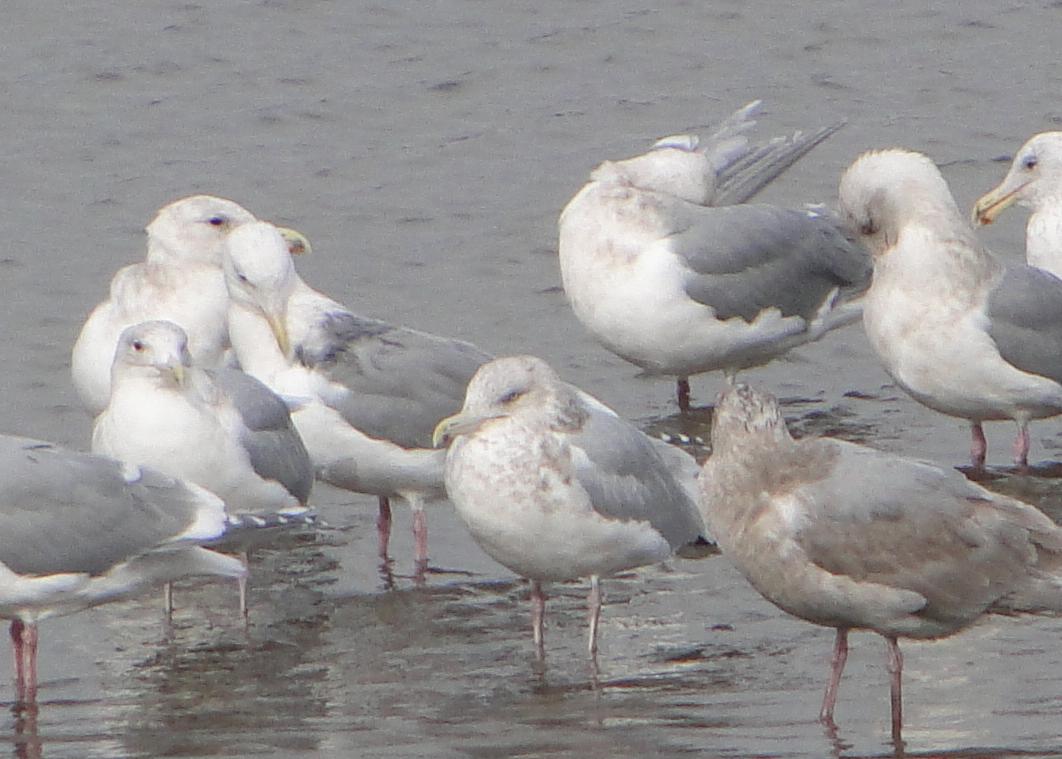
Saturday Feb 18, 2012 Ken Brown led a small group of 5 ABC birders, Brian, David, Dianne, and me on a local gull trip, and here is a rundown of the morning part of the trip.  I had to leave at midday unexpectedly so I’ll ask Dianne or Ken to make a comment to outline the afternoon birds  We birded two general areas, the Hylebos waterfront off Marine View Drive, and the Gog-li-hi-te wetlands area in order to study gulls.  It’s a good thing we were looking for gulls, because nearly every other bird in their right mind was taking cover from the high winds and precipitation, both rain and hail.

At the waterway log booms we had good looks at Mew Gulls, a few Glaucous-winged and Olympic Gulls (GW-Western Hybrids), and a couple of Western Gulls.  Saw all three cormorants, two Pacific Loons, Bald Eagles, and a pair of courting Red-tailed Hawks.

Off to the wetlands, and there we found lots of gulls, at least a thousand, maybe more in total. At the mouth of the Puyallup river we had at least one Thayer’s gull along with the GW/Western blends.  Several Mew gulls too.  Back on the rooftops at the Gog-li-hi-tee area on the rooftops and trailers around the rendering plants the flocks were thick. We found both a Herring Gull and several  Thayers gulls there.

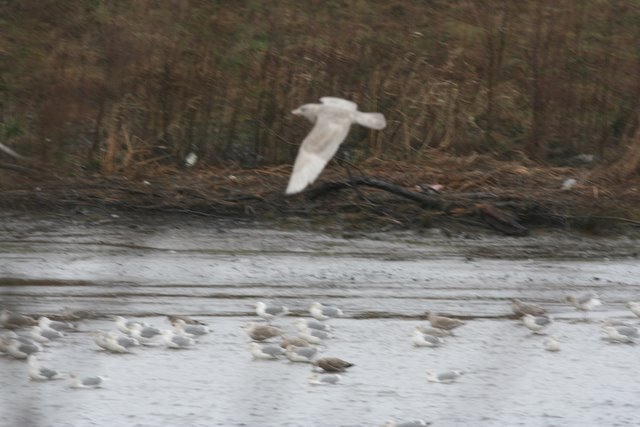
The best viewing of the day though was at the back mitigation pond where on the mud and in the shallow water were a few hundred loafing gulls.  In the near ground were Mew gulls in all three Feb. plumages, i.e. Juvenile (B1), B2 and Adult, with varying degrees of early PA molt. Lots of GW gulls and hybrids of all 4 plumages and best of all nice looks at Thayer’s gulls both adult and juvenile, and adult Herring gulls. We also found one gull that we think is either a Glaucous hybrid or Glaucous gull.  We got only suboptimal photos.  We had a few California gulls too. Gulls give a great opportunity to study and understand molt, and we worked that angle with Ken’s help all morning. So for the day we had GW, Western, Mew, California, Thayers and Herring gulls, missed Ringed-bill giving us 6 of the expected 7 for the day, with a possible 7th if we figure out the mystery gull was a Glaucous.

Here is a photo by Diane, and I’ll try to get some of mine in order to put up soon.  See you Thursday.

Herring Gull 2-18-12 by Dianne Y-Q.


Gull ? Glaucous from Gog-li-hi-tee 2-18-2012


Ed

KENT PONDS

I participated in Roger Orness’ GNRA Census of Kent ponds today. We saw 2 Tree Sparrow’s that were quite willing to give us very good looks. Best way to access the Kent Ponds is to take 228th East and exit onto Russell Rd which is now one way. There is a loop trail between the two entrances along this road. The Tree Sparrows as well as White Crowned, Golden Crowned, Song Sparrow and Spotted Towhee could be seen along this path. Other birds of note on Publicly accessed interior trails were Sharp- Shinned, Coopers, and Red-Tailed Hawks, a Harrier, Kestrel and a Peregrine Falcon. Wayne Sladek

Washington Shorebird GISS Notes

Ken’s helpful class handout on the GISS of Washington Shorebirds

GISS  General impression structure shape

Black Bellied Plover:  240gms., about size of G. Yellowlegs, larger than A.Gold.Pl., chunky large headed, thick chest, primaries slightly past tail. run stop feeding.

Am. Gold.Pl.:  145gms., attenuated, slim neck & chest,long legs-toes completely past tail in flight, usually 4 primaries exposed, wings 1/2″ or more past tail tip.  run stop feeding, upland also.

Pac. Gold. Pl.:  130 gms., same size as American, recalls BB Pl. ie front heavy upright, rounded body, heavy chest, ie. dumpy, 3 primaries exposed, 1/2″ or less beyond tail, long tertials, run stop feeding, upland.

Snowy Pl.:  40gms., slightly smaller than semi-palm, rounded front heavy, large headed slim billed, run stop plucking beaches, salt lakes, alkali flats, light backed

Semi-Palm. Pl.:  45 gms, intermediate between peep and sanderling, chunky but attenuated, round head, stubby bill, run-stop feeding beaches, mudflats, scattered flocks.

G. Yellowlegs:  160gms., 2x weight of Lesser, long legs, neck & bill, prominent adams apple, active feeder, walks steadily picks at surface, often runs frantically to chase fish, flooded fields, marshes, tidal creeks. bill upturned.

L. Yellowlegs:  80gms., slightly smaller than dowitchers, delicate, slim chest & smoot body contours, small head, slim straight bill. walks rapidly and methodically, picking, seldom runs, flooded fields, shallow ponds, mudflats.

Solitary Sand.:  50gms., Midway between peep & Lesser Yellowlegs, compact, short wings, legs & neck, slightly larger head, moves slowly and nervously picking at surface, ponds, creeks, marshs, solitary, spotted above.

Willet:  215 gms. near G. Yellowlegs, stocky and more compact than G.Y. larger head, thick neck & bill, walks steadily picking, shallow probes, tidal creeks & flats.

Wandering Tattler:  110gms, close to red knot, slim & attenuated, short legs, medium lengh bill, horizontal stance, walks quickly over rocks, teeters like spotted, picks & probes, usually solitary, loose flocks. largest rock piper.

Spotted Sand:  40gms. slightly larger than peep, short legs & bill, horizontal stance, active walks quickly picking, shallow fluttery flight close to water surface.

Whimbrel: 390gms., larger than willet, smaller than LB curlew, bulky & attenuated, long neck decurved bill, stipes on head, walks steadily, picking & probing, mudflats, marshes.

LBilled Curlew:  590gms, distinctly larger than Godwit or Whimbrel, heavy body, long decurved bill, no stripes on head, walks steadily picking & probing, mudflats, pastures.

Hudsonian Godwit:  300gms, willet size, heavy chest, long pointed wings, upturned bill, white rump & wingstripe, walks steadily, deep prober, mudflats, flooded fields, very rare.  15.5″.

Marbled Godwit:  370 gms, larger than willet, bulky body, long legs, abreviated supercilium, upturned bill, steadily walks, probing deeply, mudflats.

Bar-tailed Godwit:  340gms, between Marbled and Hudsonian in size, shorter neck and legs than Hudsonian but longer bill, walks steadily probes deeply, mudflats, tidal flats, widening supercilium behind eye.

Ruddy Turnstone:  110 gms, slightly larger than sanderling, chunky short legs & neck, short bill, low croucher, flips debris, digs in sand also cobbled habitats.

Black Turnstone:  120gms., chunkier than ruddy, short neck & legs, chisel like short bill, croucher, flips debris, rocky areas.

Surfbird:  190gms., 10″, 2nd largest rock piper, chunky, short stout plover like bill. Active, walks quickly over rocks, tugs or pecks.

Rock Sandpiper:  70 gms., slightly larger than dunlin, chunky and rounded, medium to long droopy bill, croucher, walks steadily, picking, hops & fluttters from rock to rock.

Red Knot: 135 gms., dowitcher size, chunky, short legs, medium bill, horizontal stance, walks slowly picking and probing, sandy beaches, mudflats.

Sanderling:  60gms, size of dunlin, larger than peep. chunky rounded body, large head, thick neck. medium bill, picks at surface, chases waves. whitest shorebird in winter.

Semi-Palm Sand:  25gms, 6.25″, slightly larger than least, plump body, not as front heavy as Western, straight blunt-tipped bill, deeper at base than western. walks steadily, picks nervously, aggressive mudflats.

Western Sand:  26gms, 6.5″, front heavy, larger head, longer droopy finer tipped bill, roosting birds more upright than Semi-palmated sandpiper, picks & probes shallow, large flocks migration, with dunlin winter, mudflats.

Least Sand:  20gms. 6″, medium bill fine tipped, roosts more upright than S-P, crouches when feeding, bill tip close to toes, walks steadily, picking broad mudflats close to shore, often higher on mudflats.

Baird’s Sand:  38gms, 7.5″, slightly larger than peep, steep forehead, straight fine tipped bill, long wings often crossed, walks steadily, picking, dry edges of mudflats, short grass.

Pectoral Sand:  73gms., 8.75″, Larger than dunlin, Males largest, bulky broad chested, but attenuated. small head, longer neck and legs than Baird’s. Primaries to tail tip. picks at surface, mudflats, pastures, ponds.

Sharp-Tailed Sand:  68gms, 8.5″, similar to Pectoral, more rounded body, longer legs, shorter slimmer bill, not 2 toned, red cap, buffy chest, with Pectorals usually.

Dunlin:  60 gms, 8.5″, Sanderling size, chunky, short thick neck, long droopy bill, dun colored, rapidly picks & probes, winters here in good numbers, large flocks by default.

Stilt Sand:  58gms, 8.5″, dunlin sized, smaller than dowitchers, long legs, fine tipped droopy long bill. walks steadily with bill down, probes deeply or picks at surface, often belly deep in ponds, shallow water, submerges head.

Buff-breated Sand:  63gms, 8.25″, size of Pectoral, sleek, attenuated, squarish head, short straight bill, upright stance, walks quickly with pigeon-like gait, (head bobbing), short grass, plowed fields, dry sandflats.

Ruff:  150gms, 11″, female close to Lesser Yellowlegs, male close to Greater.  chunky, round body, long legs & neck, short droopy bill, hunches when feeding, upright when alert. active, wanders continuouly, picking & probing,  ponds, marshes, flooded fields often with yellowlegs.

Short-Billed Dow:  110gms, 11″,  size of Lesser Yellowlegs, chunky but attenuated, short legs, long bill, horizontal stance, usually slimmer and flatter backed than LB in relaxed feeding pose, bill shorter, thicker at base, with longer curve at base, probes deeply, sewing machine in shallow water. mostly coastal, salt water.

Long-Billed Dow:  115gms, 11.5″, chunky, round back, indented near tail base, bill longer, thinner based, flatter for longer distance than S-B. ie curves more quickly from head.  Only winter time dowy, fresh water, ponds, sheltered tidal, sewing machine feeding.

Wilson’s Phalarope:  60gms, 9.25″, longest bill, needlelike, small head, long neck, spins in water, picking, usually inland.

Red-Necked Phalarope, 35 gms., 7.75″, smallest, compact with slim neck, small head. medium length bill, spins also, inland, coastal, pelagic.  Striped back.

Red Phalarope:  55gms., 8.5″, similar to sanderling, 40% larger than R-N, bulky, heavy chested, thick neck, large head, heavier plover like bill, 2 toned. plain back, spins, mostly pelagic, coastal after storms.


.


Washington Wrens and Dipper

Notes from June 2011 Spring Class

Wrens:  most are CBS, two CAS, most resident.  Some in NA move slightly south.  PF molt tends to be incomplete.  PF molt most extensive in Marsh, Bewick’s and Carolina Wrens.  PA reported in Marsh and Sedge wrens.  These two are more migratory.  Short distance migrants.

Bewick’s wren:  widespread W WA, locally FC E WA.  Riparian areas E WA, near Spokane, Klickitat, SE and S Central Col. Basin, local in Yakima, in W WA up to about 500’  Song more energetic and emphatic than song sparrow.

House Wren:  brushy areas low elevation, local W WA, common E WA, locally common in San Juans,  brambles, downed trees, cavity nesters, 4-15 –> 10-1, complex bubbly call resembles Lincoln Sparrow song.

Pacific Wren:  local lowlands as a breeder, more breed in the Mountains.  Split from E species as Winter wren.  Resident.  More in winter at low elevation.

Marsh Wren:  CAS, no change in appearance.  Local in E WA.  Along Col. River, Yakima area, Grand Cooley area.  Tend to pop up to recorded Virginia Rail call.  Aggressive birds.

Rock wren: migratory, short distance. Mostly absent in winter.  Rare in W WA  Recorded in all months, but most leave.  4-15 –> 11-15,  Broken rock slopes, like chutes, rock slides.  Need less space than Canyon Wrens, so can be found on small rock outcroppings, up to high elevations.

Canyon Wren:  residents, steep cliffs, almost always have water at the base of the cliff, cliffs tend to be large, 10 W WA records.

American Dipper:  CBS, most resident, some may move to slightly lower elevations in winter, first named in Mexico, hence there species name Mexicanus.  PB molt the inner 5-6 primaries synchronously, then the rest sequentially.  Tend to walk, not fly.  Move down in elevation in wintertime.

Washington Chickadees, Nuthatches and Creeper

Notes from JUne 2011 Spring Class

Chickadees

Black-capped Chickadee:  CBS, PF partial, more extensive in the south, common year round, resident, rare in the San Juans.  Riparian in E WA, low elevations but can be up to medium elevation, local in Col. Basin.  Deciduous to mixed.

Chestnut-backed Chickadee: up to Canadian zone, higher in some areas.  Common resident W WA.  No song, only a call, up to 4000’ E slope cascades, losing habitat and moving higher slightly.    Mostly conifer and mixed.

Mountain Chickadee: To high elevations.  Common in dry conifer forest of E WA, also at higher elevation 3000-timberline on W slope of Cascades, irreg. winter wanderer.  Likely to be split in the future into two species, one Gambel’s chickadee of the Rocky Mountains, and Bailey’s chickadee in our area.

Boreal Chickadee:  high elevation, usually wetter forest, more Douglas Fir with deciduous around lakes.  FR 39, above Salmon Meadows, Togo mountain is good.  Brownish cap, brownish-reddish sides, small white area on the face.

Nuthatches:  CAS.

Red-breasted nuthatch:   Molt their neck, chin and feathers because of the pitch on the conifers, so more extensive PA molt than the other nuthatches.

White-breasted nuthatch:  2 types.  Call is more nasal.  Slower yank-yank-yank.  Some rufus on the vent.

Pygmy Nuthatch:  Fairly common in dry open forest of E WA.  Local in Blues.  Series of Peeps as call.

Brown Creeper:  resident E and W WA.  CBS.  Old world species.  PF usually limited,  eccentric wing molt has been noted in PF.  Tail feater in PB is like woodpeckers, outer first and R1 last since like WP they use the tail as a prop.  Forests state wide, usually conifer more mature trees, some mixed forest, medium to high elevation, local nester at low elevation, more in wintertime with flocks of other birds.  Song high pitched, contact call a single noted see like GC kinglet which tends to be 3 or more see noted.

Washington Larks and Swallows

Notes from June 2011 Spring Class

Larks:  CBS.  Old world birds.  We only have one species.

Horned Lark:  known as a shore lark in Europe.  In NA about 25 subspecies, in WA Merili, Alpina and Streaked.  Northern birds migratory, PF is a complete molt. Live in sunny locals, so would be expected to have a PA molt, but none observed.

Swallows:  CBS.  Tree swallows eat berrys, so can stay further north.  One of the few birds who molt as they migrate.  So molt one feather at a time, and grow it back before it sheds another, so it takes 4-6 months to complete the primary molt.

Tree, VG, and Cave, and Rough-winged molt in the US whereas Cliff swallow does not,  so if you see a “cliff swallow type” molting they are a Cave.

Barn, Bank and and Cliff are long distance migrants, arrive later and molt outside the US.  PF complete.

Purple Martin:  fairly rare to uncommon as migrants, local breeders, most in W WA on salt water, rare in E WA.  4-10 –>  9-20.   Females lighter colored below.

Northern Rough-winged swallow:  FC to locally common E WA, low to moderate elevation,  3-10 –> 9-25.  Discrete, not usually in large flocks, pairs or small groups.  Need a soft substrate to nest in.  In W WA usually over or around water.  Blunt tail, slightly notched at times, evenly colored on the back.  Smudgy on the breast, Chin smudgy.  Young birds rufous wing bars.  Low to mod. Elevation.

Bank Swallow:   White chin and belly with band thickest in the middle, more notched tail, on the back the body is more grayish brown and the wings brownish, look at the back in flight look for the two toned upper body.  Have been seen as migrants and possible breed in Whatcom.  Large colonies in E WA at places.  3-20 –> 10-1,  4-15 –> 9-20 in W WA.  To 2300 feet.

Violet-green Swallow:  2-20 –> 10-15, low to mod. Elevation, local at higher elevations.  Common in towns, cavity nester.  Eye in the white.  Young are brownish and can be mistaken for R. Winged, look for saddle bags, if sitting look at wing length.  Very long past the tail.

Tree swallow:  cavity nester, fresh water ponds, usually low to mid elevation, 2-15 –> 10-25.

Cliff Swallow:  widespread,  3-15 –> 10-15, low to mod elevation,

Barn Swallow:  Last to arrive, 3-10 –>  11-15.   4-1 –>  8-10 in E WA.  Up to high elevation.

Washington Corvids

Class Notes from June 2011 Class on Jays and Crows

Jays and Crows:  CBS, resident. Pre-basic molt overlaps with breeding. For example in Clark’s Nutcracker starts PB molt in March and April.

American Crow:  Juvenile look fresh all summer, Adults molt in summer until July until fall.  First year birds start molt much earlier and molt in April – summer.

Stellar’s Jay:  Blue Jay:  mainly in winter as a migrant.  Most 8-25 à 4-1

Western Scrub Jay:  Like suburbia, esp. oak. Moving north.

Gray Jay:  In W WA 3000-sub alpine, E WA 3600 – timberline.  Juvenile birds darker.

Clark’s nutcracker:  start PB molt March-April, suspend and resume in the fall.  2 subspecies in WA, one in Ponderosa Pine with cliffs, others at high elevation  i.e. 4000 ft to the timberline assoc. with white bark pine, which grows in subalpine forest.

Black-billed magpie:  low elevation E WA.  A few W side sightings.  Resident.

Am. Crow:  news.  DNA testing shows not much difference between the NW smaller crows and the bigger crows.  Come in many sizes.

Common Raven:  fairly common W WA, common E WA.

Washington Vireos

Washington Vireos- Notes from Spring Class 2011

Most Vireos are CBS, some are CAS, most medium distance migrants, the red-eyed group are long distance migrants.  One WA vireo is a resident – Hutton’s vireo.

Cassin’s Vireo:  4-10 à 10-1  (general dates) like dry open conifer and open forests, mixed forest on W side, migrate thru a vaiety of habitats, found in local and dispersed areas, uncommon W WA, riparian mixed forest and in black cottonwood or maple on W Wide, E side dry conifer forests.  NE Olympic peninsula, San Juans, and Pierce Co.  Spectacles.  We only have 4 vireos.  So first on seeing a vireo see if there are wing bars.  2 with (Hutton’s and Cassin’s) and 2 without (Red-eyed and Warbling)  Like all vireos bill has a little hook on the bill, thicker bill than warblers.

Red-eyed Vireo:  No wing bars, long distance migrants, dark line thru the eye, white eye stripe, clear breasted, locally fairly common to common breeder in NE WA and E WA, absent Columbia basin, medium elevation, riparian, esp black cottonwoods, in W WA big leaf maple.  5-15 à 10-1,  many more on the E side.

Warbling Vireo: no wing bars, weak eye stripe, no black thru the eye, deciduous up to sub alpine, 4-15 à 9-20.  Most arrive about May 1st.

Hutton’s vireo:  CBS, resident, 2 wing bars, broken eye ring, no black behind the greater coverts, look big headed compared to RC Kinglet, more deliberate, mostly sing in March and April, sing occasionally.  2 noted song, over and over.  Like edges up to 1500 feet in WA, deciduous and conifers with mixed forest, absent Olympic Peninsula, only 3 E WA records.  Hop deliberately form limb to limb.

White-eyed vireo:  One record on Vashon Island

Yellow-throated Vireo:  one record.

Blue-headed vireo:  2 records (only split 1998)

Philadelphia Vireo:  2 records.

Bell’s vireo:  one record at Skagit fall 2007.